Blog
Introducing projects at context
Your team's work is your most powerful AI context. Stop letting it evaporate.


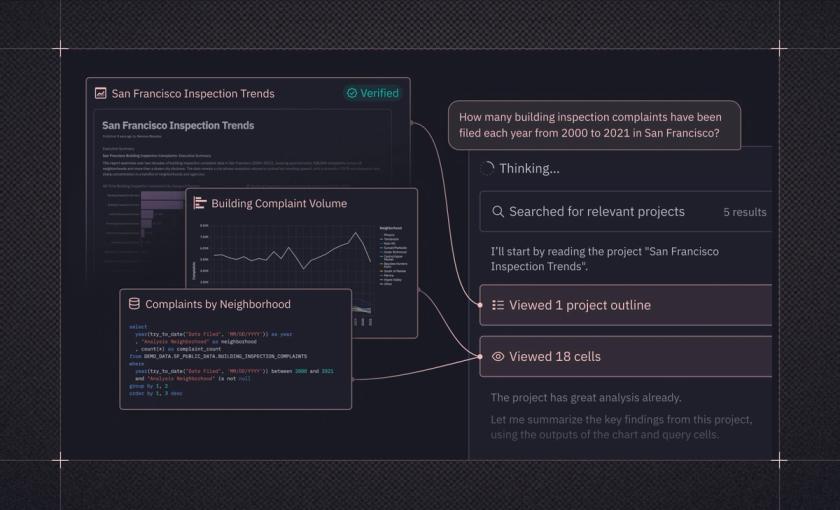
The irony of context in AI analytics: we've spent so much energy manually building it — semantic models, curated skills, meticulously maintained data catalogs— when your teams have been generating the richest context imaginable all along. It's just been evaporating.
Every trusted analysis they shipped. Every key metrics dashboard. Everything your team has built for stakeholders. All of this signal for your agents is often just lost.
We call it context exhaust. It escapes most other tools, but capturing it scales your data team's knowledge in ways manually curated context never could.
Today, every team using Hex can finally put it to work — no effort required.
Projects as context
Hex’s agent can leverage existing work, no matter the surface you’re working on. This means that projects are used as context, whether you’re in Threads, Slack, MCP, or the Notebook.
Projects are automatically searched as the agent investigates how best to help you answer your question. If you want to be more specific, you can also @-mention a project or drop the URL to explicitly tell the agent what to review.
For business users
A sales leader may want to ask a question about pipeline velocity. Instead of generating SQL from scratch, the agent first checks:
Has someone in this organization already answered this?
If there's a trusted project that covers it, the agent surfaces that work and can share the existing dashboard rather than starting from scratch.
And now, when they inevitably have a follow-up question that isn’t quite answered in an existing dashboard, rather than pinging the data team to make an update, the agent can leverage the base queries, the chart, and the logic — and can use it as a reference to answer the users’ questions.
For analysts
The Notebook Agent has always been great for from-scratch analysis. Now it can inherit context from work that already exists — and that turns out to be surprisingly useful the moment analysis gets complicated.
Your hundreds of cells deep into an exploration that branched off a key metrics dashboard, and now something looks off. Perhaps an incorrect filter, a subtle join error - there’s an infinite list of potential issues that would be impossible to spot yourself.
Now you can reference that dashboard directly, have the agent review your logic, and find exactly what’s different.
For the data team
Writing docs has always meant manually bridging a gap — extracting logic from your dashboards and copying it somewhere an agent can reference, with nothing to keep the two in sync. Every time a dashboard changes, your docs are now stale. It's the context curation tax in its most tedious form.
Now you can reference a project directly with an @-mention or URL. The agent reads the guide first and, if needed, can view the full project to see the referenced queries, text cells, or generated charts. Keep guides clean with higher-level business context that's less likely to go stale.
The best context you have is work you've already done. Now you can use it.
Point to trusted work
We all have those messy projects, scratchpads, or roads to nowhere, stuff the agent shouldn’t search for to find a trusted answer. The Hex agent respects Endorsed Mode, returning assets that have been marked as “endorsed.” That way, you can continue to use Hex for scratch ad hoc work but also as the elevated source of truth.
Not sure what to endorse? Start by checking out your most popular referenced Hex dashboards in the project tab. Remember, you can bulk endorse via the API.
Context that compounds
Most tools can use the context you bring to them. What they can't do is automatically learn from the work you create inside them.
Every query your team runs, every analysis they ship, every metric definition that went through three rewrites before it was right — that work accumulates. In Hex, the agent learns what your organization has already decided to trust. It stops starting from zero.
You built that context to solve a real problem. Now the agent can use it too.
If this is is interesting, click below to get started, or to check out opportunities to join our team.