State of Data Teams 2026

Issue 02

About this survey: In December 2025, Hex re-surveyed 65+ data leaders — VPs of Data, directors, analytics engineers, and individual contributors — about their priorities, investments, and blockers. Respondents span company sizes from 80 to 1,000+ employees.

Just six months after our first State of Data Teams Report , the shift was clear: attitudes toward AI moved fast.

Data teams are hitting the gas on AI – but trust remains a concern

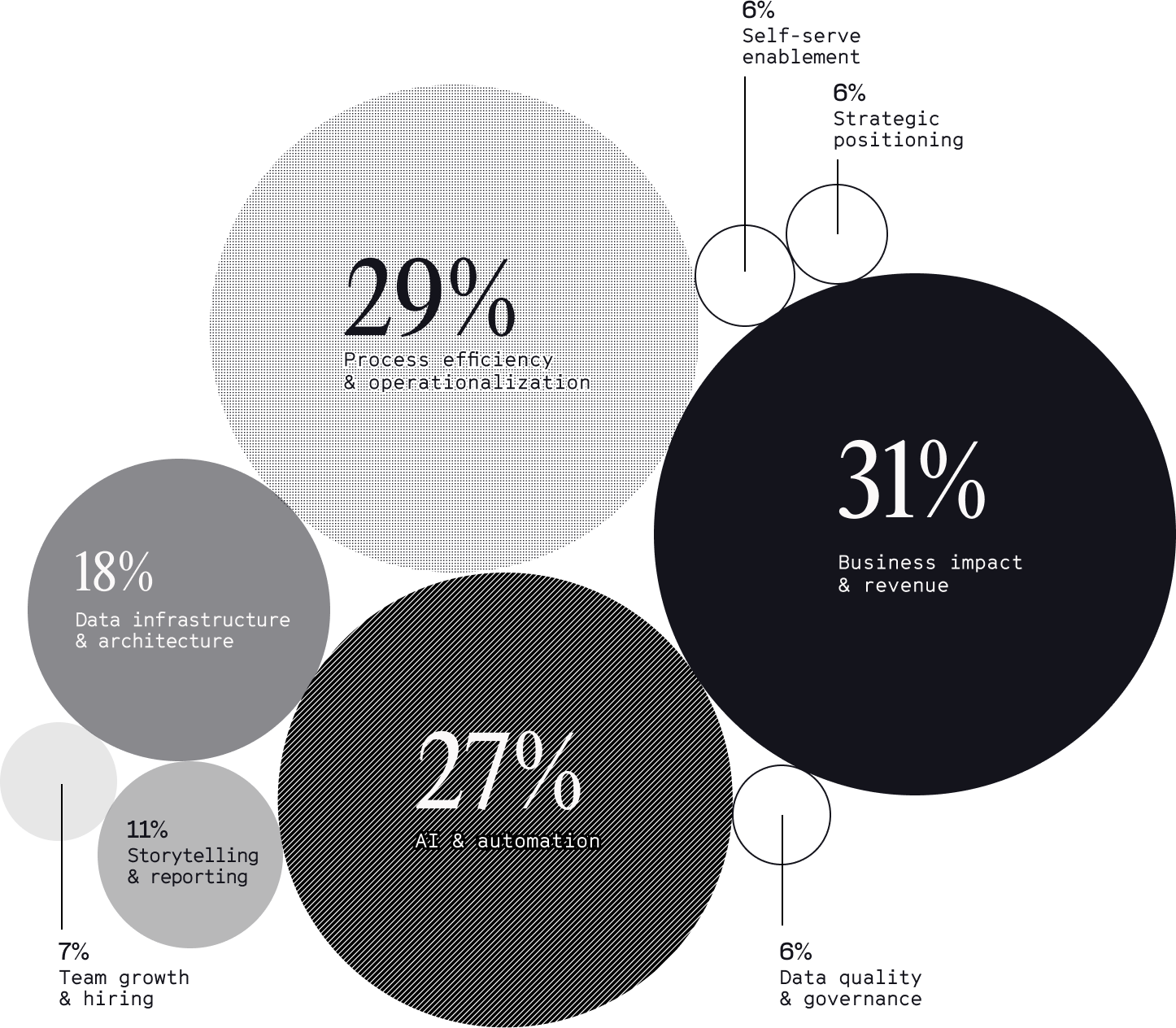
In this most recent survey, “AI and automation” jumped to a top goal for data teams. Last Spring, only 3 respondents mentioned AI as a goal for their team.

But it’s not just a goal — data teams are already putting hours into activating AI. In a list of focus areas, AI ranked second, with the number of respondants calling it an important area increasing by 24% compared to the last study.

But moving full speed ahead on AI doesn't mean the road is entirely smooth; the majority of respondents said that data trust is the #1 concern around AI adoption (which was cited nearly twice as much as any other concern). To address trust and accuracy, data teams reported investing in a variety of governance layers for AI to be more accurate. Semantic layers, once controversial, are seen as essential to this shift.

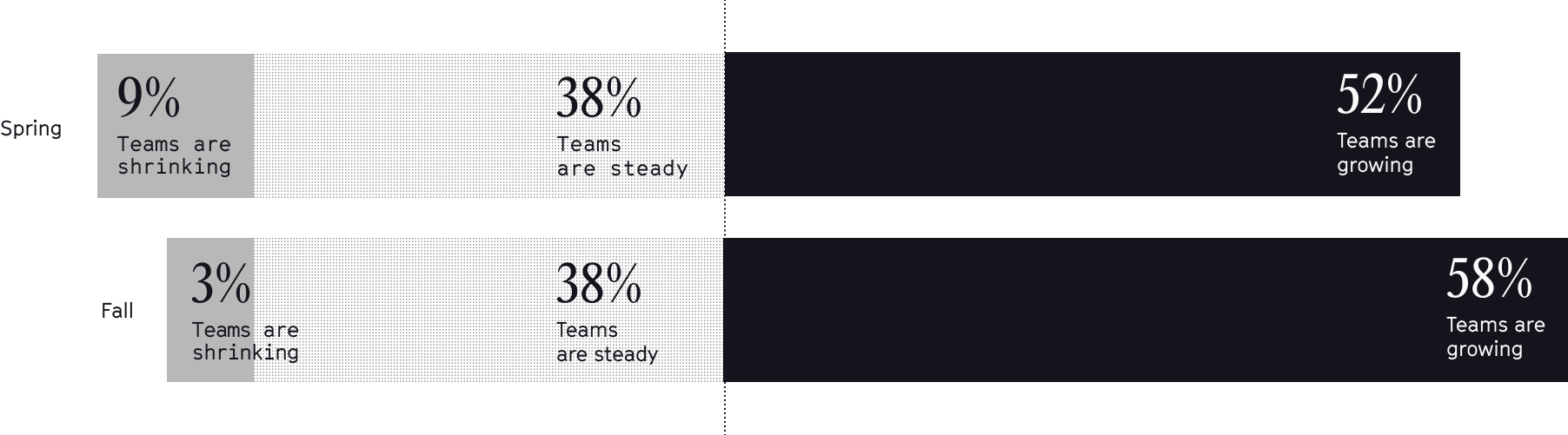
And despite concerns about AI replacing data work, the opposite is happening. 58% of respondents reported their data team grew, up from 52% in spring — a signal that AI is reshaping data work, not eliminating the need for it.

Let's get into the details.

Key findings

  • AI as a data team priority surged 575% in six months: only 4% of leaders cited it as a top goal in Spring 2025; 27% did by December 2025

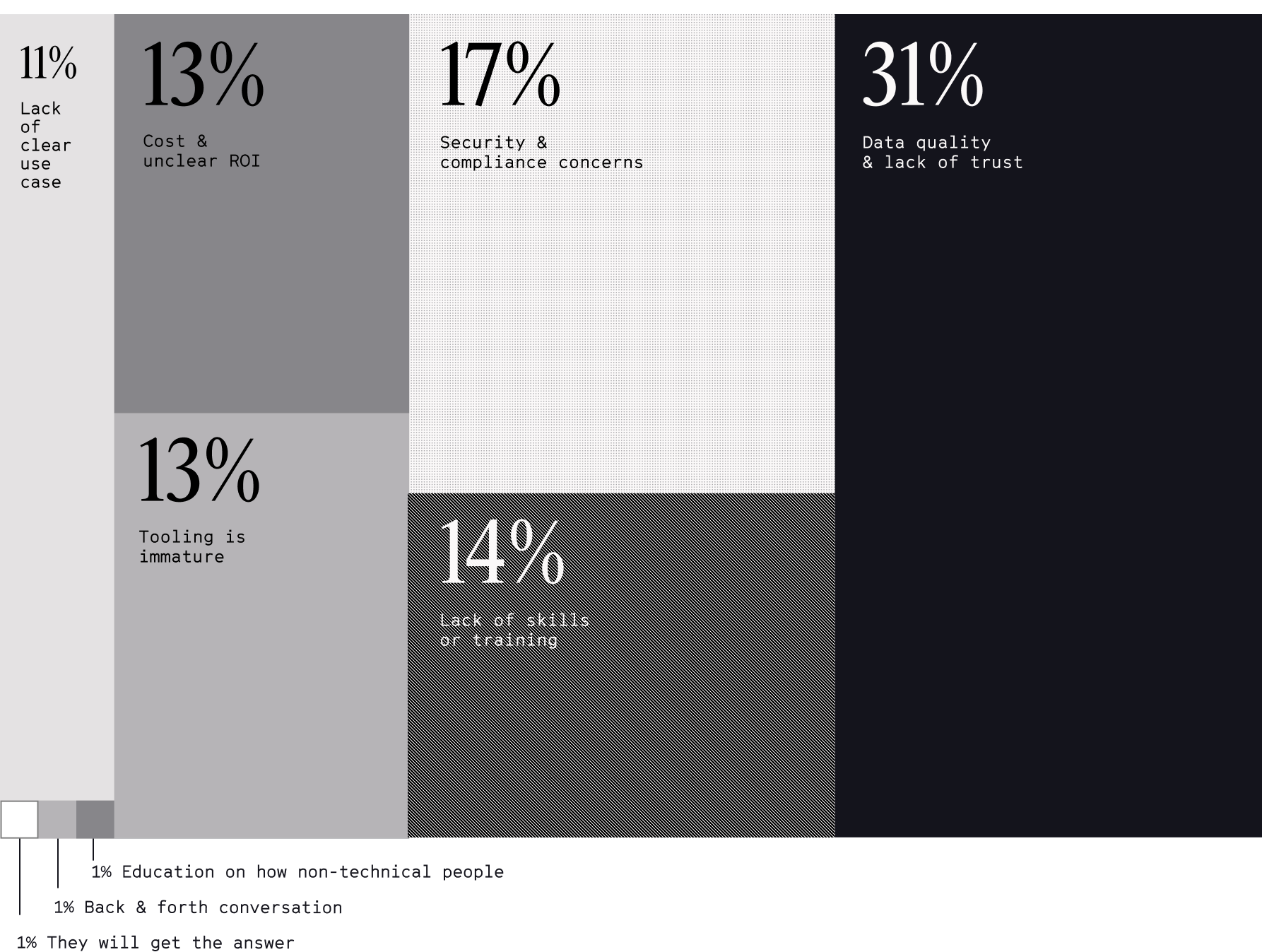
  • 31% of data leaders cite trust and data accuracy as their #1 AI concern — nearly 2× the next most common barrier

  • 58% of data teams grew by late 2025, up from 52% in spring; only 4% reduced headcount (down from 9%)

  • AI tooling jumped from 6th to 2nd in data team focus areas, a 24% increase in six months

  • 0% of data leaders predict they'll avoid AI entirely

  • Semantic layers are now consensus: no respondent questioned their value in fall (vs. a minority of doubters in spring)

01

01 AI is a top priority for data teams

AI became a data team priority faster than almost anyone predicted. Between spring and fall 2025, the share of data leaders naming AI as their #1 goal jumped from 4% to 27% — a 575% increase in six months.
AI is one of the top goals for data teams

When we asked data teams about their top goals, they frequently mentioned AI & Automation, representing a dramatic shift in priorities over just six months. In Spring, AI barely registered as a concern — only 4% of respondents mentioned it as a top goal in free-text responses. By December, that number had surged to 27%.

This wasn't a gradual trend — it was a rapid acceleration. Teams moved from cautiously exploring AI to actively implementing it, driven by competitive pressure, leadership buy-in, and increasingly mature tooling options.

(note that these percentages add up to more than 100% because we allowed respondents to list multiple goals. It’s ok to have complex feelings)

Bubble chart: top data team goals for 2026 — business impact & revenue leads at 31%, followed by process efficiency (29%) and AI & automation (27%), based on survey of 65+ data leaders

On a scale of 1-5, how big of a priority is the following for you and your data team?

AI tooling focus surged while self-serve and data quality declined
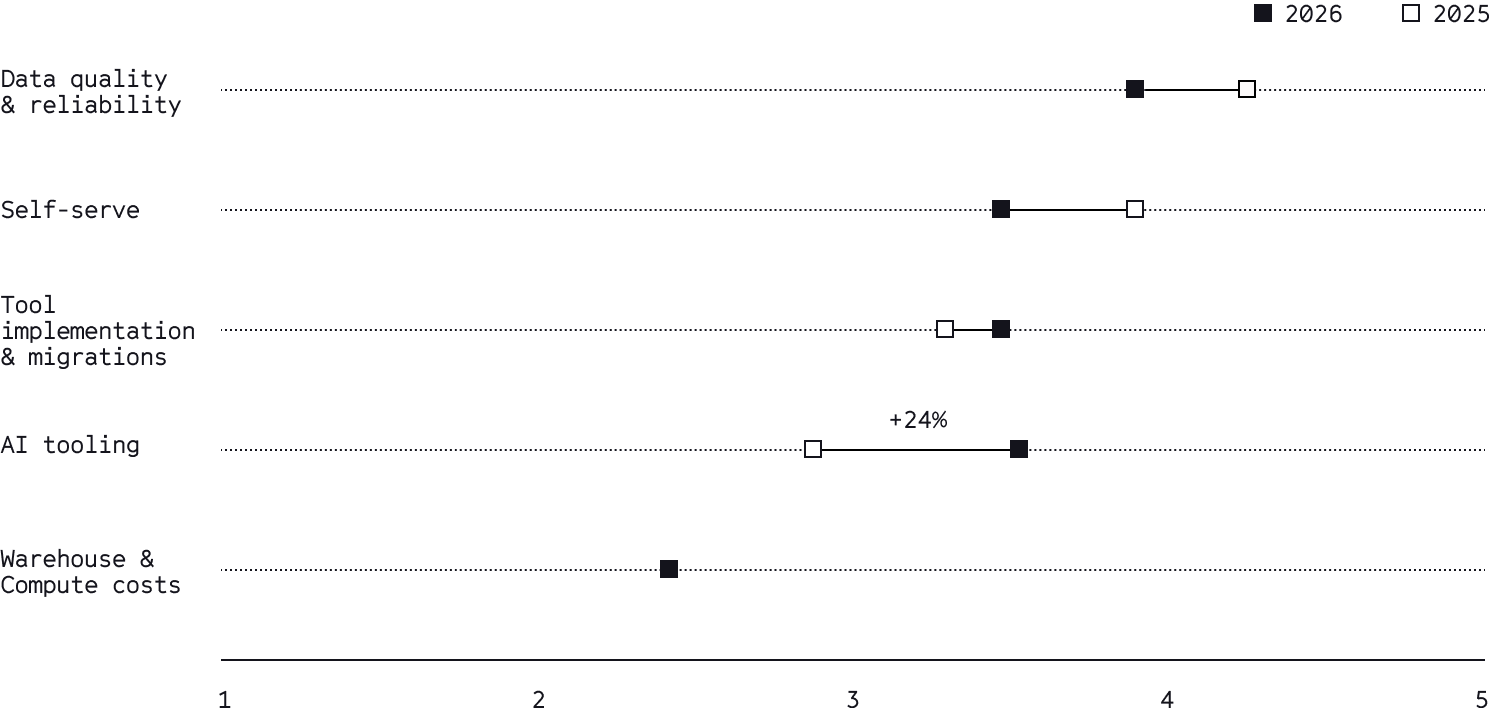
Dumbbell chart comparing data team focus area priorities 2025 vs. 2026 on a 1–5 scale: AI tooling jumped the most (+24%), while self-serve and data quality & reliability declined slightly

AI has gone from excitement to implementation

When we asked data teams what responsibilities they were focusing on last spring, “AI tooling” was the penultimate choice, taking 6th out of 7th place. But by the end of the year, it jumped by 24%, knocking out ”enabling self-serve” as the second biggest area data teams are spending their time. This reveals that AI is not just a goal, but already adopted in data team workflows.

With trust being a common concern about AI-generated data insights, it’s unsurprising that data quality is still a top concern.

What is one big goal you have for your team in the next year?

"Move and build faster with AI."

CEO, 300-person Tech company

02

02 Trust and data accuracy are the biggest concerns for AI

Data teams are broadly optimistic about AI, but 31% say data trust is their biggest obstacle — cited nearly twice as often as any other barrier.

The majority of people feel positively about AI, but data quality is the biggest barrier to adopting it.

In Spring, nearly half of respondents surveyed said AI was overhyped [or that they were worried about it taking jobs]. Now a vast majority have a positive sentiment toward AI, with 52% saying it’s a great tool for builders or a centerpiece of self-serve.

When asked what the biggest barrier to adopting AI was, the majority of respondents reported a lack of trust. Data quality and concerns about AI hallucinations are slowing adoption and creating a new challenge for data teams to focus on.

Mid-level managers, who are closer to the data, feel the pain more than executives (+17% vs VPs at -15%).

Trust dominates AI adoption barriers

Treemap chart of AI adoption barriers: data quality and lack of trust is the largest barrier at 31% — more than twice security concerns (17%) or skills gaps (14%)

Data cleaning leads trusted context strategies

Donut chart: how data teams are building trusted AI context — cleaning & organizing data leads at 41%, followed by semantic models (25%); 14% report not doing much yet

Teams are using a variety of methods to build context.

The dominant industry narrative in 2025 was that semantic models were the silver bullet to enabling AI on data. Today, data teams are investing in a variety of techniques, from better data organization to semantic layers, governance tools and AI rules files.

It’s an indication that data teams are taking a broader view of context as their organizations get serious about AI in production.

In a change from Spring, no one is questioning the value of semantic models now.

While semantic models aren't the dominant method for ensuring data quality, no one is questioning their value anymore. In Spring, a few respondents had doubts.

Now, the majority report having one in their BI tools and many who previously doubted them have adopted a standalone semantic layer, fearing vendor lock-in.

More customers are building semantic layers, and fewer are doubting their value.
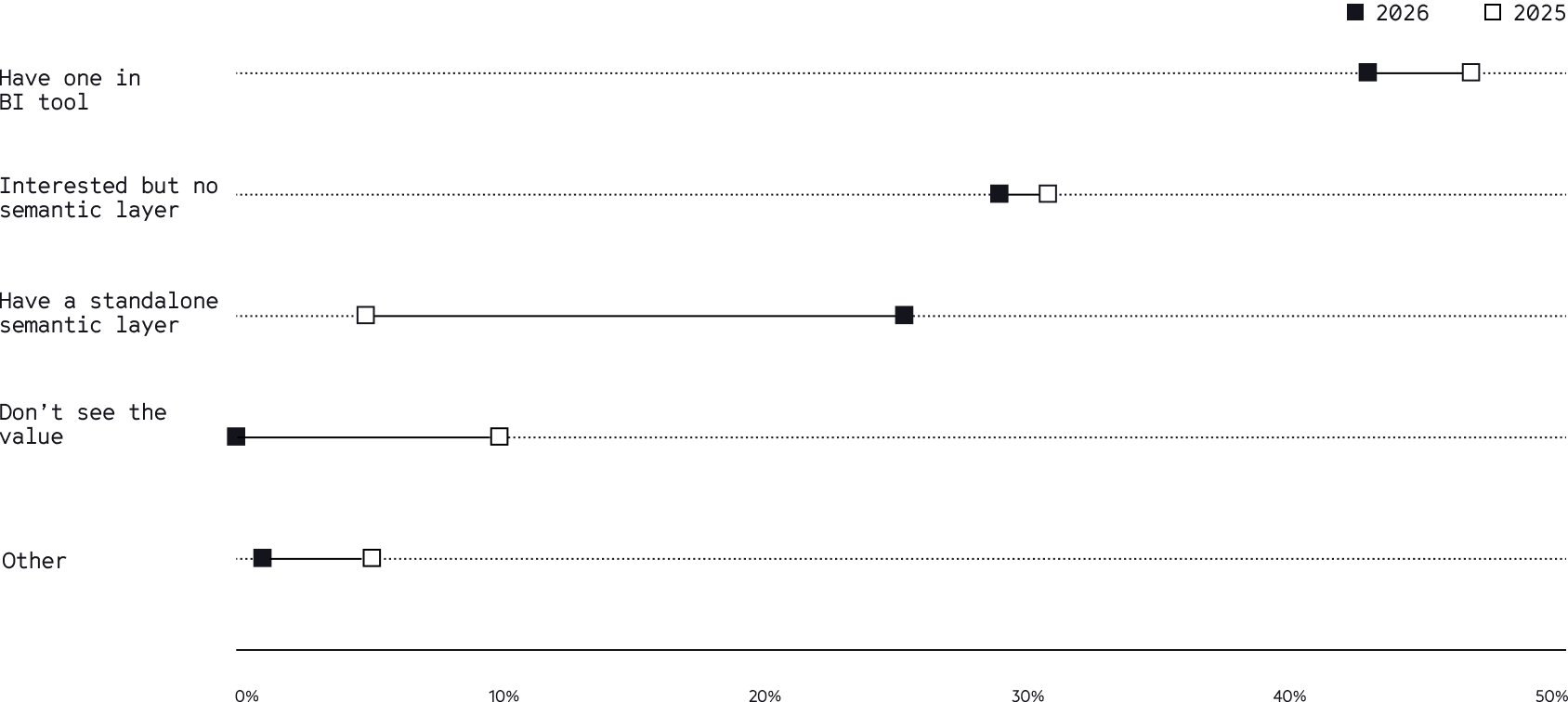
Dumbbell chart: semantic layer adoption spring vs. fall 2025 — standalone semantic layer adoption tripled (~8% to ~28%); respondents who 'don't see the value' dropped from ~12% to ~2%

What is one big goal you have for your team in the next year?

"Standing up our Intelligence product for AI/ML use cases internally and externally."

CTO, 80-person data company

03

03 Leaders and practitioners want different AI tools

Data leaders envision more specialized AI-on-data tools

LLMs have had an immediate impact in helping handle data questions, with many data teams mentioning that they ask questions of data in tools like ChatGPT and Claude. However, with doubts mounting around trust and accuracy, a lower percentage of data leaders predict these tools will be used in the future.

The biggest growth area? BI tools - few of them are enabling AI in production today, but data leaders predict they will be an important AI tool for assisting with dashboard production and reporting.

This trend away from generic LLMs and toward specialized AI tools is representative of a future where AI is a table-stakes capability in data workflows. Note that 0% of data leaders predict that they’ll avoid the AI wave altogether.

What is the relationship between current and future AI tools (among data leaders)?

Shift from general LLMs toward specialized analytics AI tools

Radar chart: current vs. predicted future AI tool usage among data leaders — BI tools with AI assistance show the biggest predicted growth; LLMs like ChatGPT and Claude expected to decline in use

What is one big goal you have for your team in the next year?

"Enhance our user interface with data via an LLM."

Marketing Director, 430-person data software company

04

04 Data teams are still growing as AI adoption accelerates

Contrary to fears about AI eliminating data jobs, 58% of data teams grew between spring and fall 2025. Only 4% reduced headcount.

As AI adoption accelerates, data teams continue to grow. Organizations are still investing in the people behind the operation. AI isn't replacing data professionals — it's making them more essential.

Spring

  • Growing: 34 (52%)

  • Flat/Steady state: 25 (38%)

  • Shrinking: 6 (9%)

Fall

  • Growing: 41 (58%)

  • Flat/Steady state: 27 (38%)

  • Shrinking: 3 (4%)

What is the state of your data team?

Stacked bar chart: data team size trends spring vs. fall 2025 — growing teams increased from 52% to 58%; shrinking teams dropped from 9% to 4%; steady teams unchanged at 38%

What is one big goal you have for your team in the next year?

"Scale agentic solutions for high volume work."

OD, 200-person web development agency

05

05 What does this all mean for 2026?

As we head into 2026, we expect to see more data teams use AI in their workflows - with an emphasis on providing trusted, accurate answers.

As teams race to implement AI, they're clear-eyed about what it takes to make it work. Context and trust aren't blockers they're waiting to solve — they're the foundation teams are actively building through cleaning, governance, and semantic modeling.

The challenges data teams are facing today - cleaning their data, moving faster, supporting self-serve, and delivering business impact, are familiar themes:

AI isn't changing what people need from analytics tools, it's amplifying those needs.

And despite all the noise about AI replacing jobs, a majority of data teams are growing. AI isn't eliminating the need for data professionals — it's creating demand for teams that can implement it thoughtfully.

AI adoption is happening fast. Teams succeeding with it aren't treating it as a magic solution — they're treating it as a tool that requires the same rigor, quality standards, and strategic thinking that good analytics has always demanded.

Questions? Talk to us.

Get in touch with us to see a demo or find out which plan is right for you.

Get started for free

FAQs

How much has AI adoption changed for data teams in 2025?
chevron-down
Significantly changing and fast. Between spring and fall 2025, the share of data leaders naming AI and automation as their #1 goal jumped from 4% to 27% — that’s a 575% increase in six months. AI went from a background interest to an active implementation priority for the majority of data teams surveyed.
What challenges do data teams face when adopting AI?
chevron-down
Data teams cite a consistent set of barriers. In Hex's State of Data Teams 2026 survey of 65+ data leaders: data quality and lack of trust (31%), security and compliance concerns (17%), lack of skills or training (14%), cost or unclear ROI (13%), immature tooling (13%), and lack of clear use cases (11%). Data quality and trust was cited nearly twice as often as any other barrier.
What is the biggest barrier to AI adoption for data teams?
chevron-down
The #1 barrier is data quality and lack of trust, cited by 31% of respondents and nearly twice the next most common concern. Security and compliance (17%), lack of skills or training (14%), and cost or unclear ROI (13%) follow. Teams are optimistic about AI but want accurate, trustworthy outputs before going all-in.
How are data teams building trusted AI context?
chevron-down
Most are layering multiple approaches. 41% focus on cleaning and organizing data. 25% use semantic models. 10% rely on governance built into their tools. 8% use AI rules files. 14% report not doing much yet — a sign that context-building is becoming a baseline expectation for data teams deploying AI.
What happened to semantic layer adoption in 2025?
chevron-down
Skepticism collapsed. In spring, a minority of respondents questioned the value of semantic layers. By fall, that number dropped to near zero. Standalone semantic layer adoption tripled from roughly 8% to 28%, as teams sought to avoid vendor lock-in and build more portable context infrastructure.
Are data teams growing or shrinking as AI adoption increases?
chevron-down
Growing. By fall 2025, 58% of data teams reported increasing headcount, up from 52% in spring. Only 4% reduced headcount, down from 9% six months earlier. AI isn't replacing data professionals; teams that implement it thoughtfully need more people, not fewer.
What AI tools do data leaders expect to use more in the future?
chevron-down
BI tools with AI assistance show the biggest predicted growth. Few teams use them in production today, but data leaders expect them to become a primary AI surface. Notebook tools with AI agents are also expected to grow. Generic LLMs like ChatGPT and Claude are predicted to decline in use as more specialized, data-native tools mature.

Can't find your answer here? Get in touch.