Hex 4.0 is now in public beta, and available to all users with an editor role or higher. For more information on how to get started with your first 4.0 project, see our docs. We look forward to your feedback!
Suddenly, data teams have had a lot of things dropped on their plate: Their organizations are working around legacy BI, pulling in scattered context, burning tokens, and passing around “vibe-coded” HTML files – a massive sprawl of AI data stuff that nobody can govern or observe.
On one hand, this is great news: finally, people are able to use data in their day to day! Self-serve is here?
On the other, it’s a nightmare: they’re stuck managing code they didn’t write, answers they didn’t review, and apps they didn’t even know existed.
Introducing Hex 4.0: a truly agent-native platform for analytics
Today, we’re introducing Hex 4.0 to solve exactly this. It’s the next major version of our platform, built to embrace AI agents and code, with the context and controls necessary to make it actually work for your company at scale.
With 4.0:
- It’s easier than ever to ask questions from Hex’s UI, or external agents like Claude, Codex, or Cursor, and then publish and share them securely
- It’s finally possible for data teams to have a first class tool for reviewing agent-generated analytics code to know how something was built and if anyone should trust it
- Apps in Hex run way faster due to our all-new execution engine
Perhaps most importantly, 4.0 sets the foundation for a huge number of new workflows for Hex that previously wouldn’t have been possible.
Build from anywhere, with context and controls
If you run a data platform right now, it can feel like you’re stuck. Leadership wants every team using AI for data, and they’re already doing it with whatever they’ve cobbled together. Meanwhile, the official BI platforms your team has been maintaining are tied to clunky AI harnesses attempting to adapt legacy systems for new technology.
You can try to shut down ad hoc data exploration, especially once the sprawl starts spawning arguments over whose secret dashboard has the right numbers. But then you’re the bottleneck, and the best answer you can give is some version of “no, not like that!”
Hex 4.0 is built to break this tradeoff by embracing the full flexibility of code. Now every project’s core logic and visualizations are fully backed by code files (rather than a YAML spec), but rooted in governed context, with consistent logic, visual standards, and logical organization. This means it’s easy for agents to work with, and humans get the benefit of full flexibility in what they can build.
We’ve also expanded external agent capabilities so you and your team can leverage the Hex platform wherever and however you work.
For example you can start with an artifact in Claude, then easily push it to Hex and rebuild it as an app. Or, you can take a link to one of your existing Hex 4.0 projects, and edit it wherever you are.
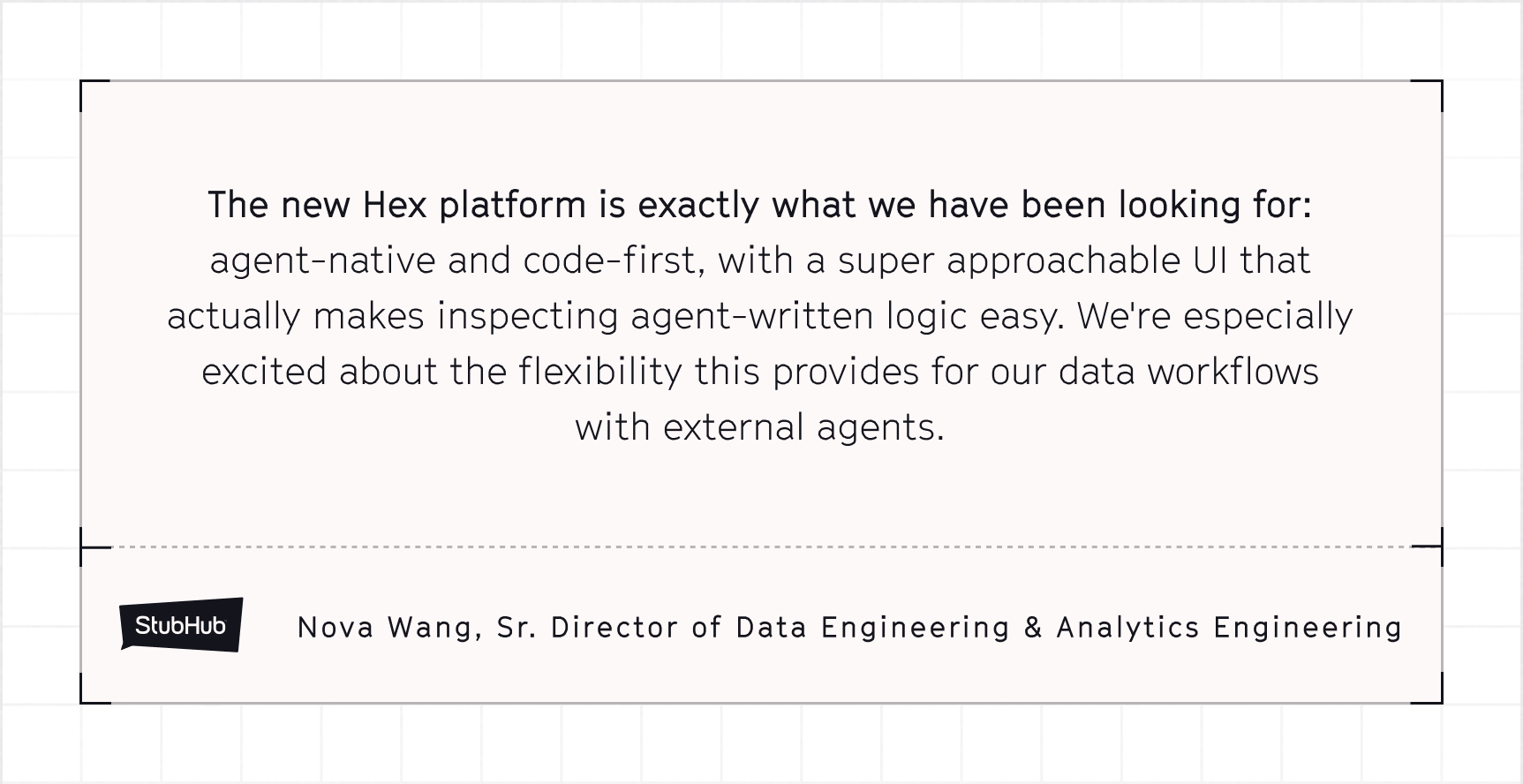
Data teams are also looking for a platform that supports all of thier agents, like StubHub, which has been one of our alpha testers on 4.0.
Published apps compound into knowledge you and your team can leverage. Once something is shared in Hex, it’s available to you and the rest of your team (and their agents!). That makes it easy to ask follow-up questions, grab the latest numbers, or pull it into other workflows.
A new, intuitive Hex UI, built for reviewing and understanding
Everyone is focused on giving teams the tools to build with data. We think the next shift is a platform build for understanding what gets built. With 4.0, any number in an app is inspectable, so you can see exactly where it came from. There’s a summary to help you get oriented and you can see the full logic plus quickly see the data sources used.
Behind the scenes, this is what our new code framework enables. The agent isn’t just writing arbitrary code files, it specifies every dependency, the full DAG, so you can trace the entire lineage of anything on the page.
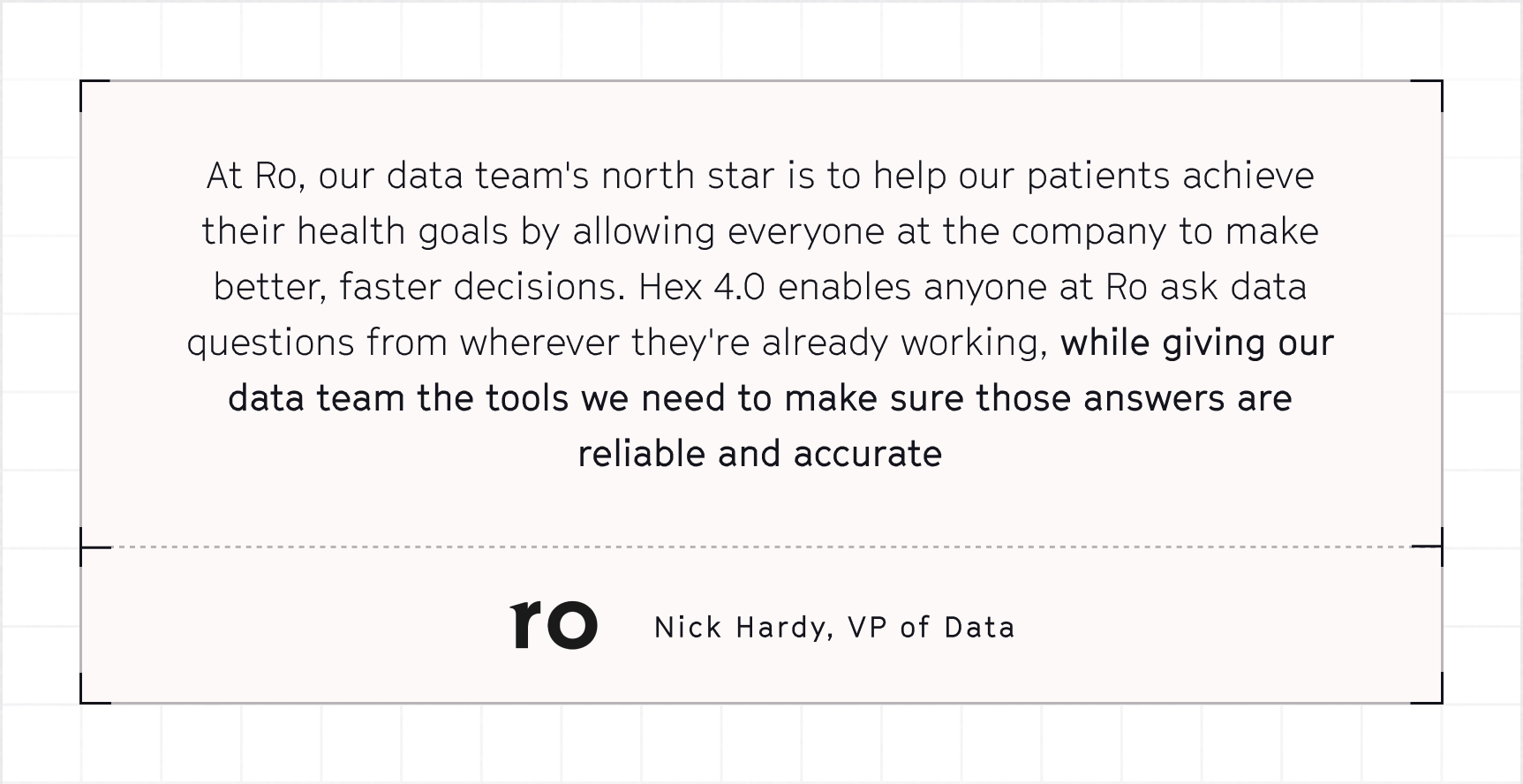
We also built this UI so non-technical users can easily gauge numbers for themselves, even if they'll never touch a notebook. They can see if a KPI in their dashboard is backed by a trusted semantic model, or if it's a tangle of complex logic that needs additional eyes from the data team. This has been an early boon to Ro, another one of our alpha testers.
As part of this evolution of Hex's platform, we’ve also reimagined the Notebook as a collaboration surface between humans and agents. You can still write and tweak code by hand, but a huge part of the job is navigating what an agent has written.
An all-new, ridiculously faster execution engine
We’ve rebuilt our execution engine from scratch, so apps run way faster, especially large, interactive ones.
Rebuilding our compute architecture allowed us to make major improvements:
- Parallel logic execution: if two queries don’t depend on each other, they run at the same time instead of waiting in line. Apps with several warehouse queries feel this most.
- Results stream in as they’re ready. Each chart, table, or KPI shows up the moment its step finishes. You don’t wait on cells in a tab you haven’t even opened.
- A changed input only reruns what it affects. Change a filter and Hex reruns that step and whatever depends on it. Everything else stays cached.
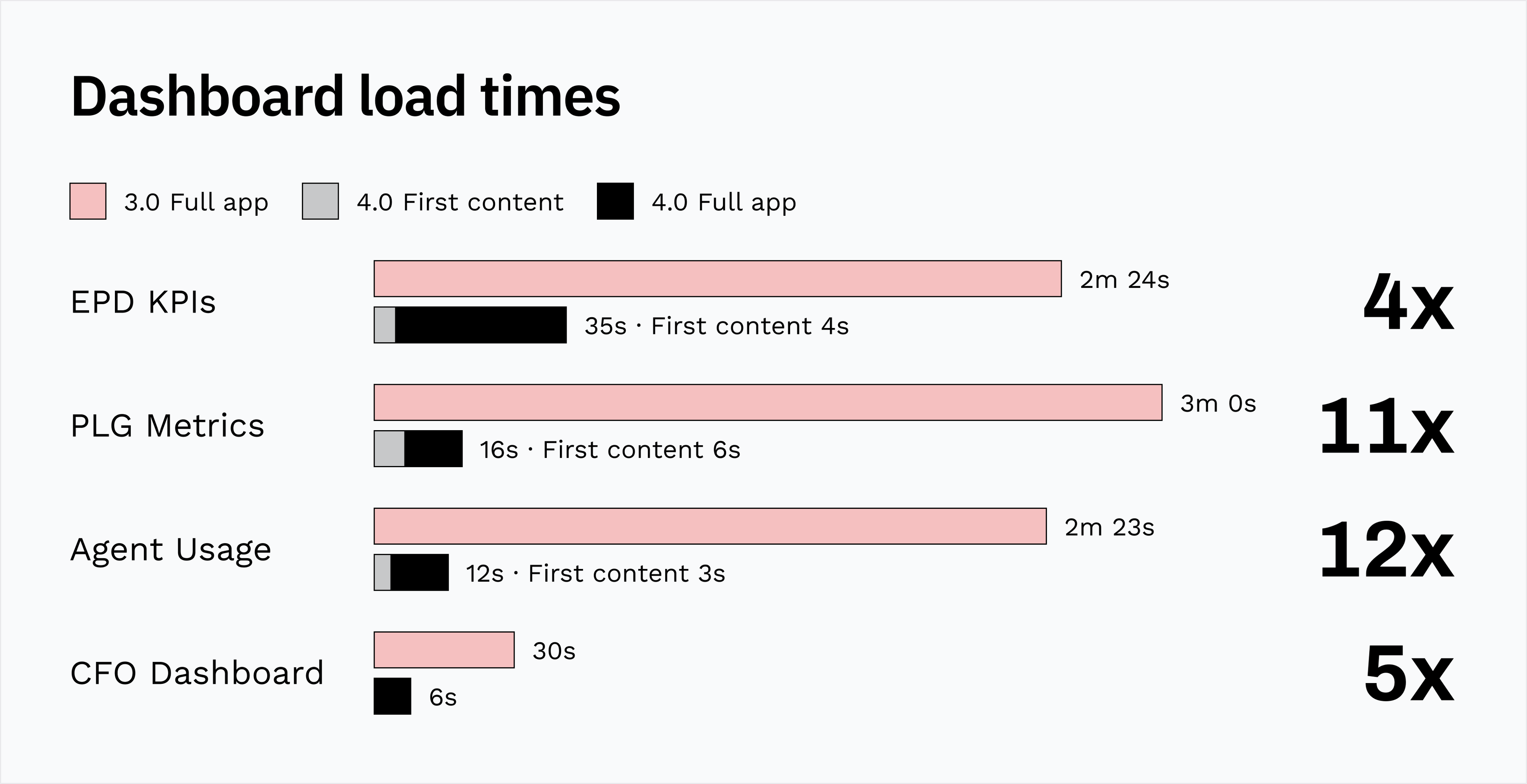
Here’s a side by side example from an internal app:
For major critical apps internally, we saw a huge improvement in full app run time.
Beyond just running faster, this unlocks a kind of app you probably wouldn’t have built in Hex before, now that highly interactive filters, drill-downs, and “what if” controls can run instantaneously without triggering a re-run of the entire project. Here’s an example app an engineer on our team built last week tracking Hex 4.0 UI usage (yes, of course we use Hex to build Hex):
What’s next & getting started with 4.0
Perhaps most importantly, 4.0 sets up the Hex platform to be far more flexible and enables us to build a whole suite of features that previously wouldn’t have been possible. We’re excited to share more on this soon.
Hex 4.0 is in public beta, and available to all users with an editor role or higher. During this period, we’re very excited to keep building in collaboration with customers. Existing Hex projects will continue to work, but we’ll soon have a first class migration workflow to make upgrading to 4.0 a breeze.
To learn more - you can check out our full docs here, and sign up for our online live event, where we’ll be walking through everything that’s possible in Hex 4.0.
We can’t wait to hear your feedback, and see what you build!
If this is is interesting, click below to get started, or to check out opportunities to join our team.