Blog
StubHub, Figma, Reddit: The new model for enterprise BI
How enterprise data teams are rethinking business intelligence, from prebuilt dashboards to AI-native self-serve.
For years, Business Intelligence (BI) tools at enterprises have followed a familiar pattern. The data team built dashboards, business users clicked around in them, and anything more complicated went back to the data team to handle.
This resulted in a lot of dashboards, very little self-service, and a data team fielding a large backlog of requests. And for many, this was just how BI worked.
As Paul Raff, Head of Analytics Engineering at Reddit put it: "[It'd be like] here’s the dashboard you go to for top level. Here’s a different dashboard you go to if you want to go deeper. And then you had to by hook or crook link those together in ways that just never really worked out.”
But now with AI, expectations of BI have changed.
Business users want to ask questions in plain language, explore follow ups, and build what they need without waiting in a queue or learning an interface. And at most enterprises, these AI workflows have already emerged whether the data team has blessed them or not.
For Meghana Reddy, Head of Data at Stubhub, it prompted a need to “give business users the power to answer their own questions and the freedom to go down their own rabbit holes as they please.”
At StubHub (NYSE: STUB) and other larger companies like Reddit (NYSE: RDDT), Figma (NYSE: FIG) and Ramp, it’s meant completely rethinking their approach to BI.
How AI changes what it means to self-serve
In today's world, business users are dropping spreadsheets into ChatGPT and Claude, and vibe-coding dashboards. And as frontier models get more capable by the month, agents can increasingly take on much of the technical work that's previously been a barrier between a question and a useful answer.
For enterprises, the challenge is figuring out how to unlock these increasingly AI-native workflows without giving up the trust and shared governance required to make them viable at scale.
At StubHub, conversational self-serve with Threads in Hex has been central to expanding data access across the company, with control.
Non-technical users at Stubhub don’t need to file a ticket or drag-and-drop, they can simply ask questions and follow-up on findings, all in plain language.
And self-service today doesn’t have to stop at getting an answer. At Figma, teams outside of their data org use Hex to work across more than 2 million data points and produce reports that once took days in 20 minutes.
With AI and BI, you don’t need to know which dashboard contains the answer or which drill path someone configured in advance. You can ask, follow up, change the assumptions, and keep going.
This gives business users the true freedom to answer their own questions, follow analyses further, and build useful things without waiting on the data team.
But the harder part is making sure all that speed and flexibility doesn’t come at the cost of trust. If answers are inconsistent and nobody can see how the analysis was produced, AI self-service can quickly turn into a governance mess.
How enterprises solve for trust in AI
When everyone has the ability to ask questions of data and build for themselves, how do you make sure the answers are actually trustworthy?
At Reddit, that tension was a requirement that had to be solved. According to Paul Raff, “There was a big question and a big pain point we had around governance and around how we can have a system that allowed us to do individual analyses but then expand this to the rest of Reddit internally.”
And Paul's not alone. With AI, there are more questions, more outputs, and more people working with data. And agents are only as capable as the context they have about your business: the metrics, definitions, terminology, and rules that tell them how to interpret your data correctly.
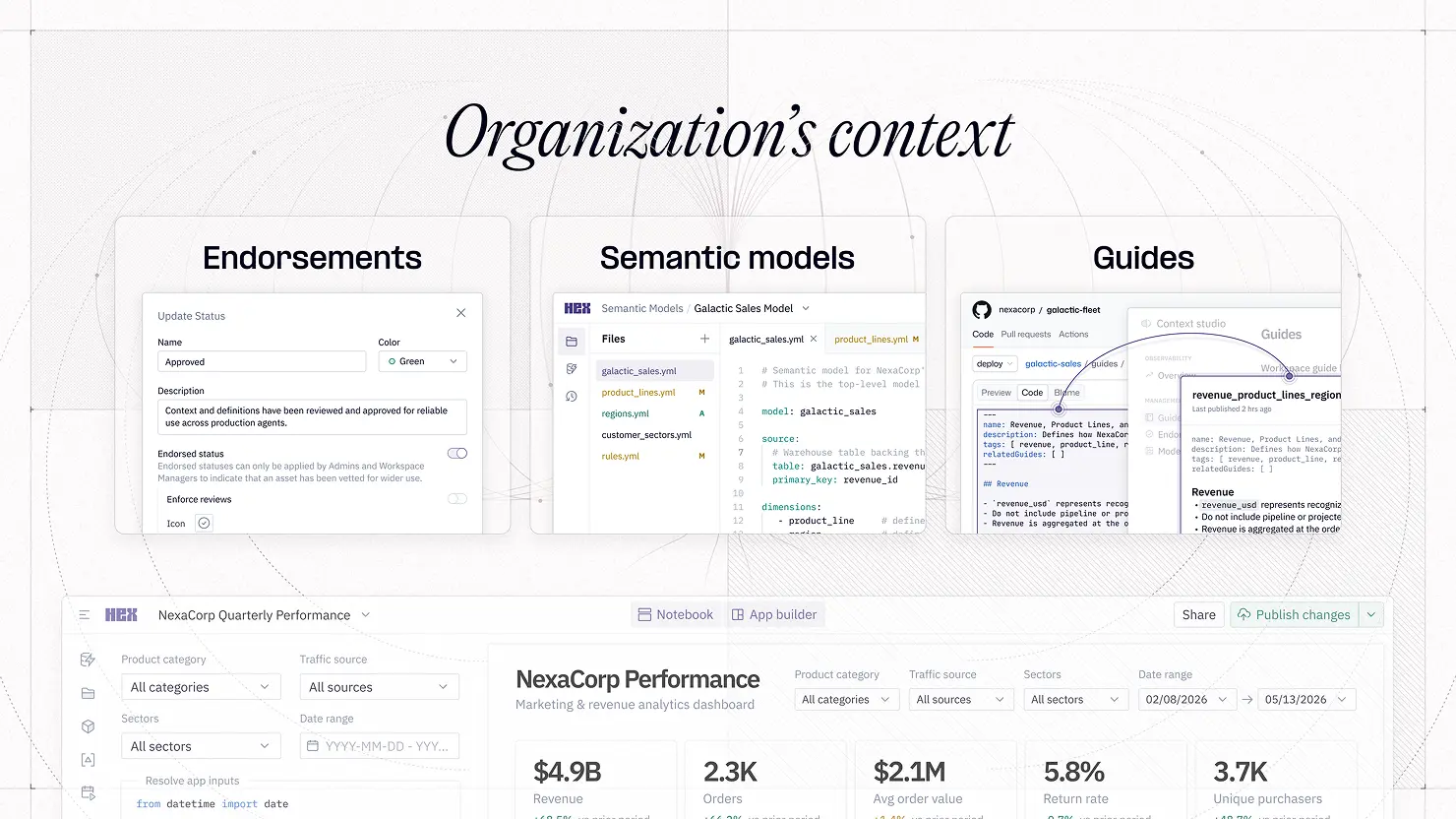
Enterprises have approached this by making context and observability core parts of their data team’s workflow. For example, the Ramp team keeps domain documentation and metadata in dbt, syncs that context into Hex, and uses Context Studio to see how agents are using it, where there are gaps, and how to make improvements.
As Ricky Meyers, Staff Data Scientist at Ramp puts it, Context Studio allows them to "See where people are working, where they’re failing, where there are warnings, where things are going okay, so we [the data team] really know where to be investing more time to build out more robust and comprehensive documentation.”
Trust isn’t something you configure once before rolling AI self-service out. Metrics change, new domains show up, and people ask unplanned questions. For the Ramp team, their workflow allows them to keep dbt and Hex in lockstep, and then use real agent behavior to see where context needs to improve.
The good news is, when it comes to getting it right with governance, you don't have to choose between flexibility and control. You can build for both.
The data team can focus on higher-value work
Even though self-serve gets data teams out of the dashboard queue, it doesn’t actually limit their influence within an organization. Instead many data teams have found their influence greatly expanded with the rise of AI-powered BI.
Take StubHub for instance. By reducing the back-and-forth of one-off requests, the data team was able to spend more time on strategic, predictive, and prescriptive work. They could focus on building out important initiatives, such as a data app for understanding the biggest drivers of ticket sales or a “Swiss Army knife” sales app that let teams explore virtually any cut of the business on their own.
Similarly at Reddit, rather than maintaining five or ten separate dashboards for one analytical journey, the data team could build interactive apps that gave business users more room to explore advanced analytics on their own.
And increasingly, building those richer experiences doesn’t mean data teams have to do all of the underlying analysis inside a BI tool. Analysts and data scientists are using Claude Code, Cursor, Codex, and the terminal to explore data, write code, and move through analysis much faster.
The challenge is making sure that work doesn’t stay siloed in a coding environment or get passed around as static screenshots and HTML files. The StubHub teams uses the Hex CLI to bring work from code-first environments into Hex and turn it into shared dashboards, apps, and interactive experiences the rest of the company can find, trust, and build on.
“We're already seeing strong pull for Hex AI across the org," says Nova Wang, Head of Analytics Engineering at StubHub. "CLI is the next logical step — it lets our most technical users build Hex into the automated workflows where AI does its best work.”
Changing the BI mindset
The data teams furthest along on AI are making a mentality shift: they’re spending less time trying to predict every question the business might ask, and more time building the context, guardrails, and systems that let people explore on their own with agents.
For many enterprise data teams, the biggest barrier to leaning into agentic analytics is the baggage they already have: hundreds of dashboards, years of accumulated logic, and a looming migration project nobody wants to take on.
But if every question no longer needs to be anticipated and prebuilt, the migration problem starts to look different. The goal shifts from attempting to recreate everything, to carrying forward the context and logic that agents actually need.
Paul Raff puts it simply: “I want to make sure that everyone at Reddit can answer the questions that they want to answer. And so I want to get away from the habit of thinking that we know what questions we want and what questions we want to answer.”
Changing that “habit” is the model companies like Reddit, StubHub, Figma, and Ramp have moved toward with Hex.
If this is is interesting, click below to get started, or to check out opportunities to join our team.


