Accuracy that improves with every answer
Skip the months-long modeling project. Hex’s Context Studio activates the logic you already have and learns from every answer.
The fastest way to sharpen agents on your data
Unified context
Activate logic from dbt, Git repos, and docs, then build on it in Hex or throughout your stack.
Observable everywhere
Track and audit any answer no matter where questions are asked: Hex, Slack, MCP, CLI.
Improves with use
Hex learns from every interaction, sharpening context and improving accuracy on the fly.
AI-powered assistance directly into your Hex projects. Write and edit code, ask questions, and get answers all in one place.
Ask natural language questions and get AI-powered insights based on semantic models and warehouse tables
Write and edit semantic resources using natural language. Describe the model you want and let the agent generate or update it.
Chat with App enables users to ask natural language questions and get AI-powered insights from published apps.
Interact directly with Hex from your terminal. Get projects, create cells, and manage users from the command line.
Unified context
Hex turns definitions and logic into trusted business context for agents to reason from, without locking you in.
Activate existing logic
Markdown, code, table metadata. Hex ingests and understands it for trusted answers without exhaustive modeling.
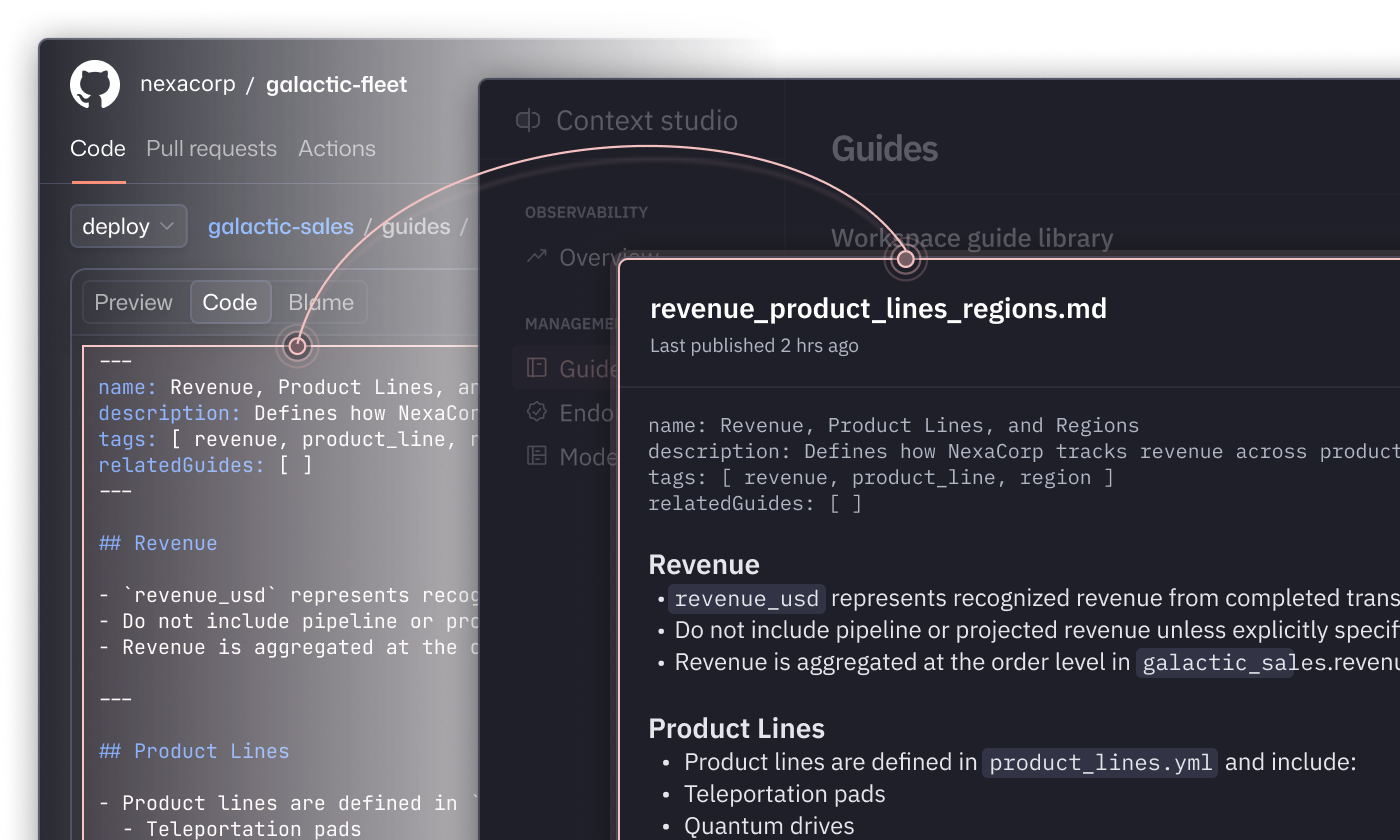
Build from anywhere
Layer in new logic in Hex, dbt, or your warehouse. Hex keeps it synced and versioned, without locking you into one tool.
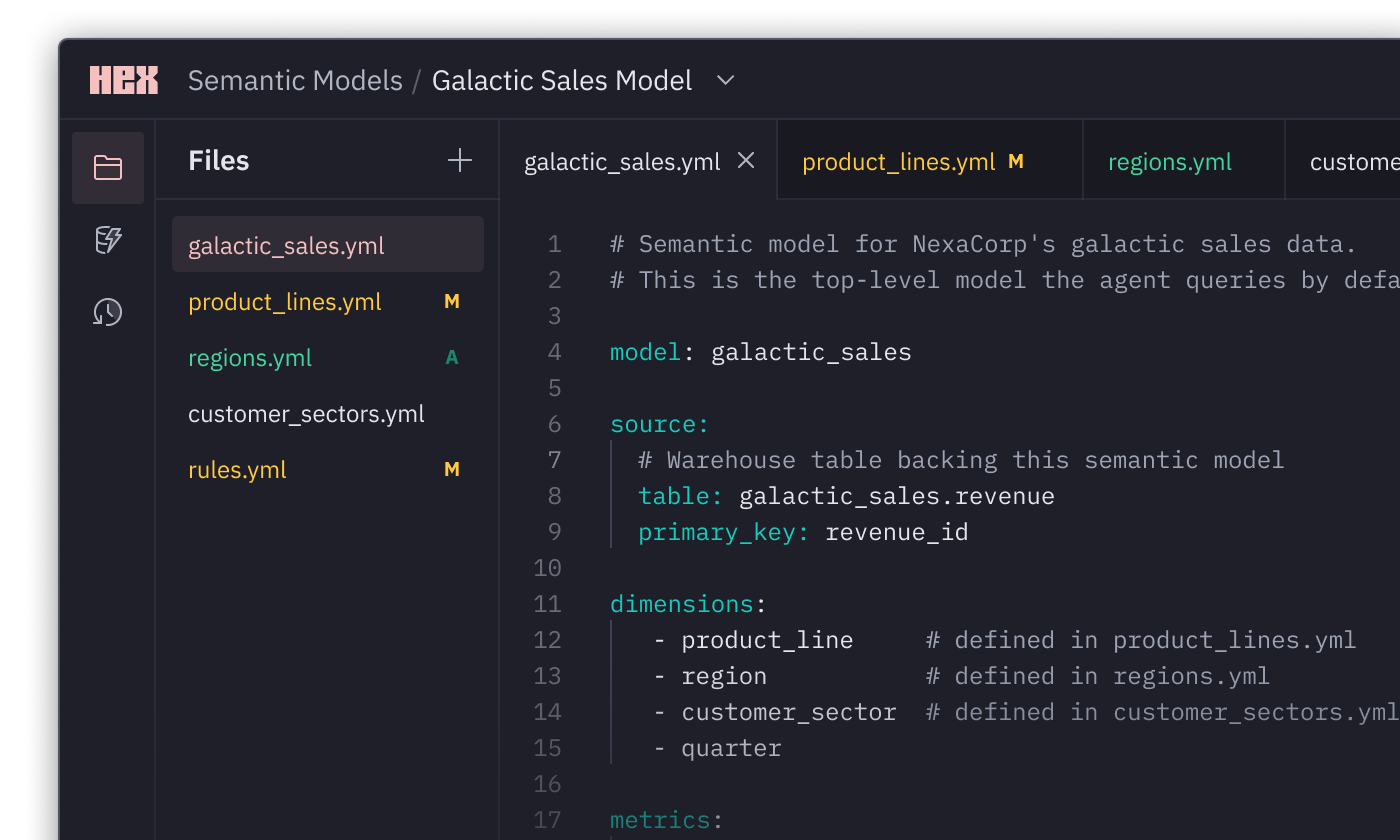
Observable everywhere
Questions get asked everywhere: Slack, Claude, Cursor. Hex gives you visibility into every answer and every step the agent took.
Trends surfaced automatically
Track agent adoption across all of Hex surfaces. See question domains that are growing, trending, or newly emerging with Topics.
The agent suggests improvements
Warnings surface agent confusion, missing context, or user doubt. The Review Agent tells you exactly what to fix.
| DATE | AGENT | PROMPT | TOPIC | WARNINGS | SOURCE | USER | ROLE |
|---|---|---|---|---|---|---|---|
| 44 min ago | Notebook | How did revenue change across the Outer Rim compared to last quarter? | Revenue by Product Line | Hex | Luc Patton | Admin | |
| 1 hr ago | Threads | Which product lines saw the strongest Research-sector demand? | Sales Breakdown | User doubt | Slack | Eels Gulsen | Editor |
| 2 hrs ago | Modeling | Help me define measures and dimensions for the Core Worlds semantic model. | Sector Analysis | MCP | Andrei Leesom | Explorer | |
| 3 hrs ago | Threads | Give me a breakdown of negative customer feedback in the Outer Rim this month. | Sector Revenue | Missing context | CLI | Andrei Leesom | Explorer |
| 3 hrs ago | Threads | What are this quarter's top customer pain points in the Outer Rim? | Quarterly Trends | Hex | Andrei Leesom | Explorer |
Improves with use
Hex learns from every question asked and every answer published, so you’re always ahead of drifting business logic and emerging domains.
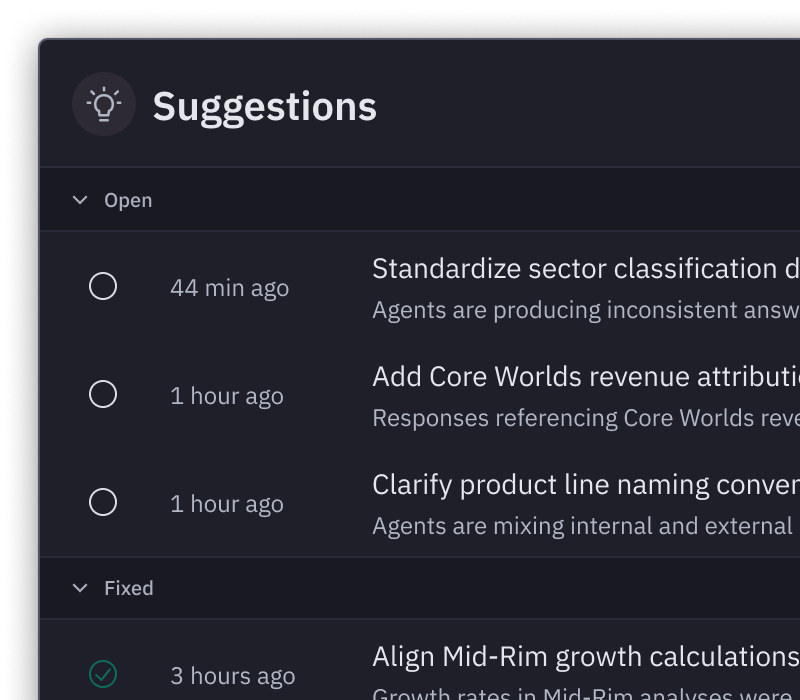
Fixes find you
The Review Agent analyzes interactions for you to find context gaps and suggest fixes.
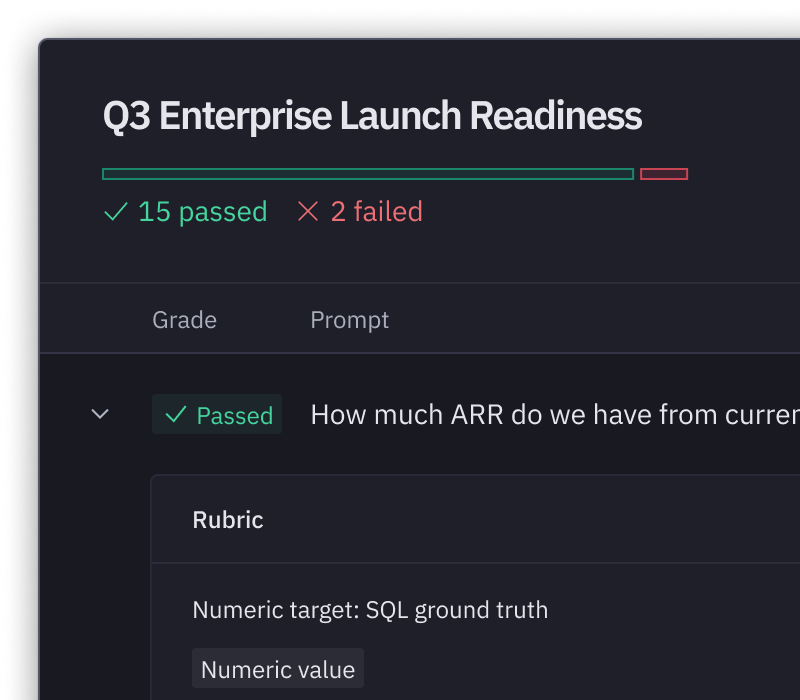
Every change, evaluated
Improve context with evidence, not instinct. Test changes with evals, ship what passes and catch what breaks.
Your work is context
The logic and queries behind every published app are reusable context for future questions.
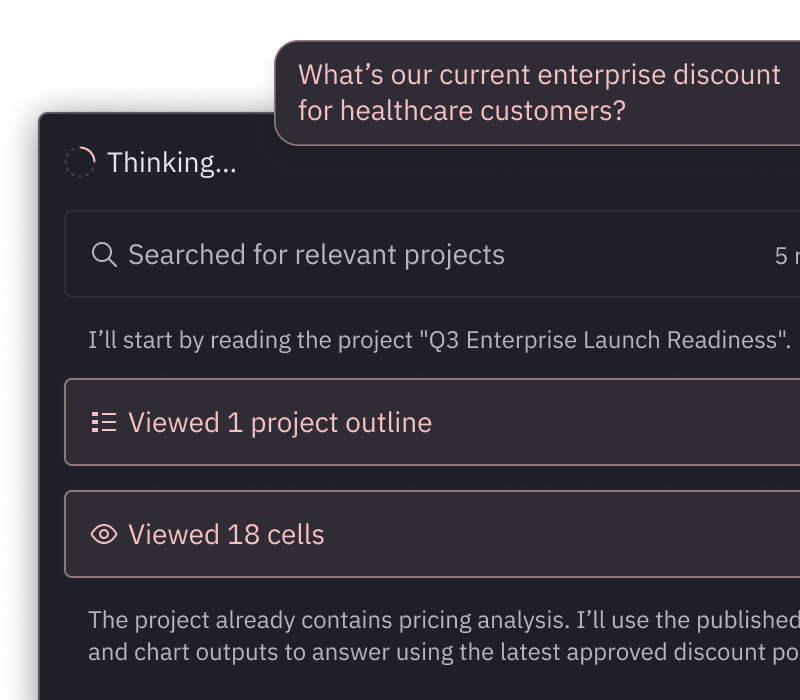

“Context Studio gives us the confidence to roll out agents on our data. It's something I check every day — seeing context gaps and suggested improvements surfaced automatically provides a practical way for us to bring trusted AI self-service to the business.”
“Context Studio gives us the confidence to roll out agents on our data. It's something I check every day — seeing context gaps and suggested improvements surfaced automatically provides a practical way for us to bring trusted AI self-service to the business.”
Build and manage context on your terms
Context curation in Hex is intentionally flexible, so it can adapt to the way your team already works.
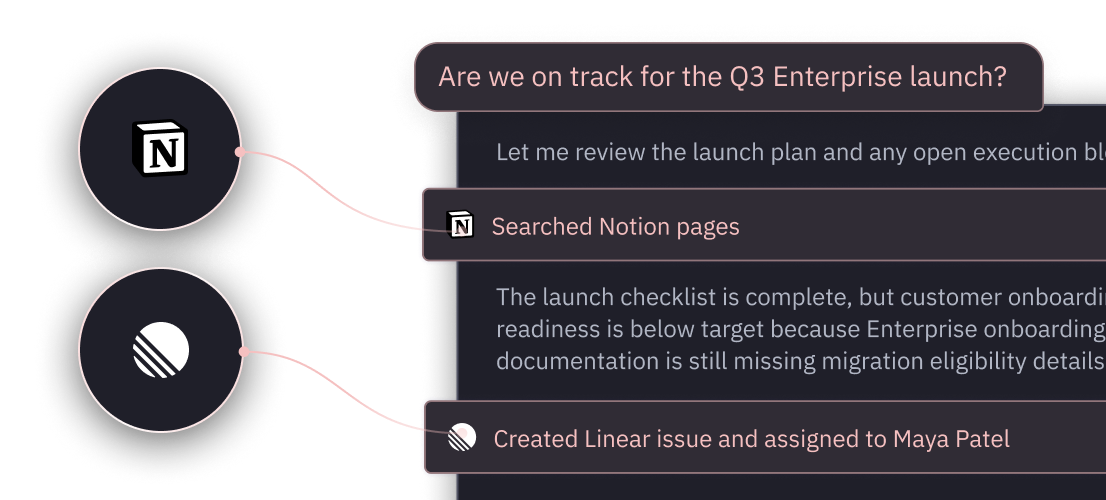
Pull knowledge from your tools
Connect Notion, Linear, or any MCP server to bring tickets, wikis, and more into Hex, so answers capture what your team knows.
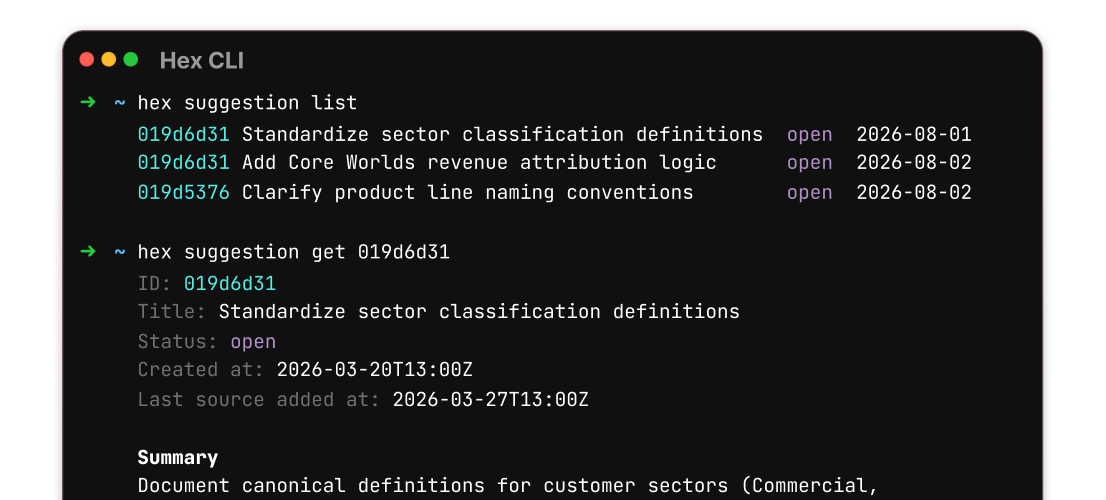
Manage context from the terminal
Use the Hex CLI to version context from Git, pull agent suggestions into PRs, and run evals before shipping changes.
Bring your semantic models
Sync semantic models from dbt MetricFlow, Cube, or Snowflake. Definitions stay versioned in your stack while Hex stays in sync.
Model only what you need
Go off-road in the Hex notebook for flexible exploration, without turning every one-off idea into permanent logic.

“Development and deployment is so speedy. Seeing my semantic model changes immediately rendered in Hex was a joy.”
Peter R.
Data Engineer at Notion

“Hex made setting up a connection to MetricFlow a breeze! The intuitive click-and-drag UI empowers our stakeholders to perform self-serve analysis.”
Mercedes W.
Data Scientist at Weights & Biases
Bring speed & trust together in Hex
Get in touch with us to see a demo or find out which plan is right for you.
FAQ
- Table metadata: column names, types, and descriptions the agent reads to understand your schema without you modeling every dimension first.
- Endorsed tables: mark certain tables as the canonical, trusted source, and the agent prefers them when several tables could answer a question.
- Reference repositories: connect a Git repo so the agent can read your code to clarify things like metric logic and table structures.
- Connected apps via MCP: pull context from Notion, Linear, and any MCP server, so answers reflect what's in your tickets, docs, and planning notes, not just your data.
- Guides: markdown files about your data and business. A workspace context file is read in every conversation, while a guide library holds topic-specific files the agent pulls in only when relevant.
- Semantic models: shared definitions of your metrics and dimensions, like what "win rate" officially means, so answers stay consistent.
- Your published work: every app and dashboard published in Hex feeds the agent, so the logic, definitions, and queries your team already wrote compound for the next question.
- Guides can live as .md files in a repo and sync to Hex automatically with a GitHub Action, so the repo stays the source of truth.
- Sync in semantic models from dbt MetricFlow, Cube, or Snowflake Semantic Views, and the definitions stay versioned in your stack.
- Where models earn their keep: a metric like ARR that has to be calculated the same way every time, everywhere it's asked.
- Where they don't: nuances about your business, like when your fiscal year starts or what a specific product term means inside your company. No need to build that into a model when it can be captured quickly in a markdown doc.
- The Review Agent watches real interactions and flags where context is missing or thin, so you're not auditing every answer yourself.
- Repeated warnings roll into concrete suggestions, so high-impact improvements come to you already scoped.
- Your published work compounds: every app and dashboard published feeds the agent, so a lot of context accrues as a byproduct of normal work, not as separate upkeep.
Can't find your answer here? Get in touch.