
FOR CUSTOMER TEAMS
Know which customers need attention before they have to ask
Make everyone on your customer team a data person
Used by data-driven customer success teams

"I started using Hex and immediately fell in love with it. It became apparent we could build fairly quickly, even before Hex had agentic analytics."
Nithin Bose VP of Customer Engineering

"I built a Hex data app that lets leadership diagnose pipeline changes in minutes. It saved me weekly hours of investigation."
Caleb Stombaugh Senior Sales Analytics Manager

"Hex made data accessible to everyone who needs it, not just the people who know how to query it. That's the difference between reacting to problems and getting ahead of them."
Ian D'Silva Strategy and Operations, Customer Success

"Hex’s Notebook Agent’s ability to build reports increases our operational speed — days into hours, which for our business, is millions of dollars."
Dhaval Patel Account Lead

Juggling four different tools to prep one QBR?
No more "can you pull the latest usage for this account?”
Build the customer health models, connect the sources, and verify the context so that you can explore, ask follow-ups, and walk into every QBR with trusted numbers.
97%
reduction in QBR prep time — from two days to five minutes.

Why does every question require a new report
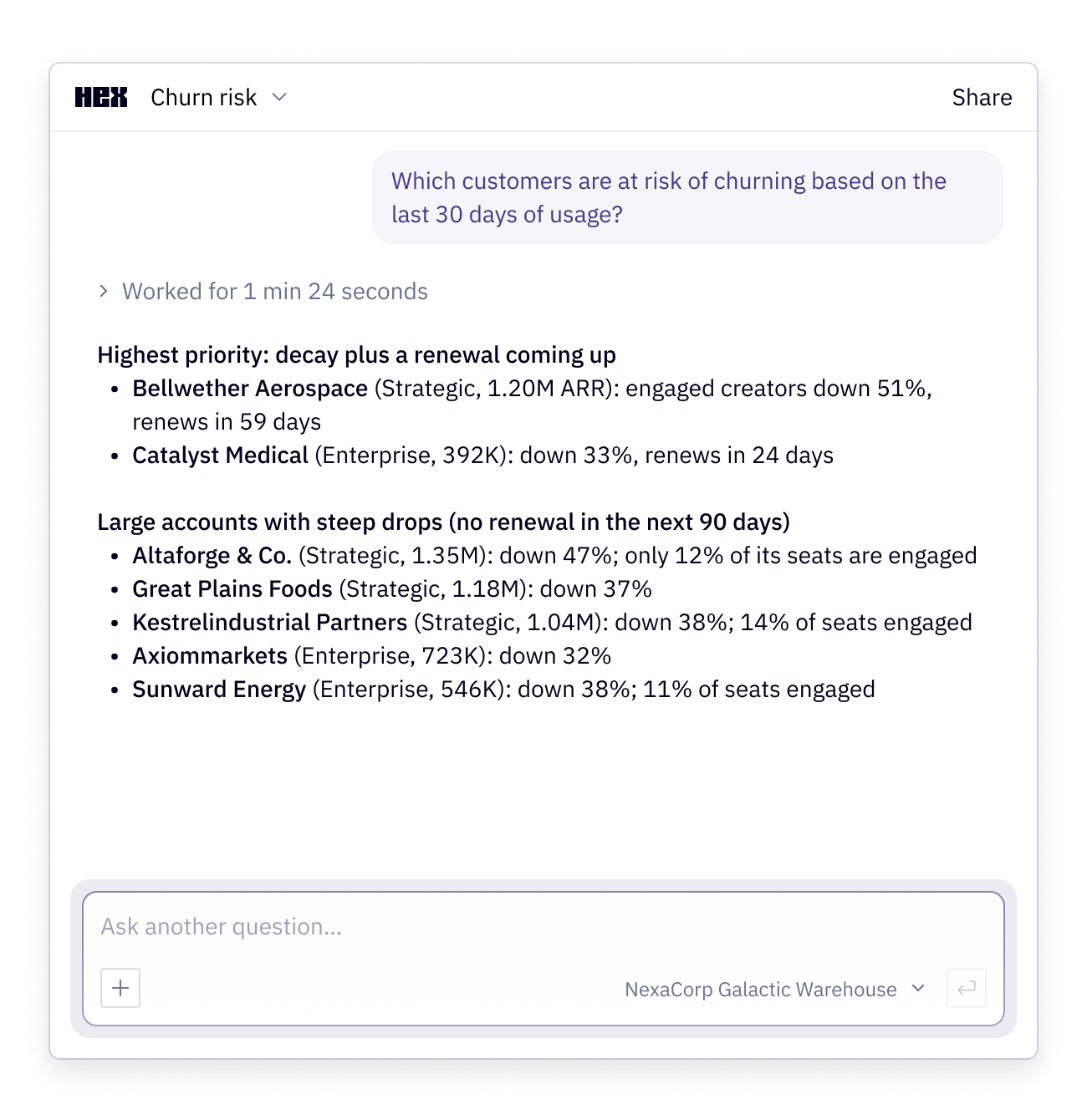
Make getting customer insights impossibly easy
Ask a question in your own words, where ever you work. Then follow your curiosity without another data request.
"With the Hex Agent, the customer engineering team no longer needed to wait for the analytics engineering team to build abstractions and YAML files to build customer insights. Now team members can chat with the data app to dive deeper with exploratory analysis."
Does it feel like churn comes out of nowhere?
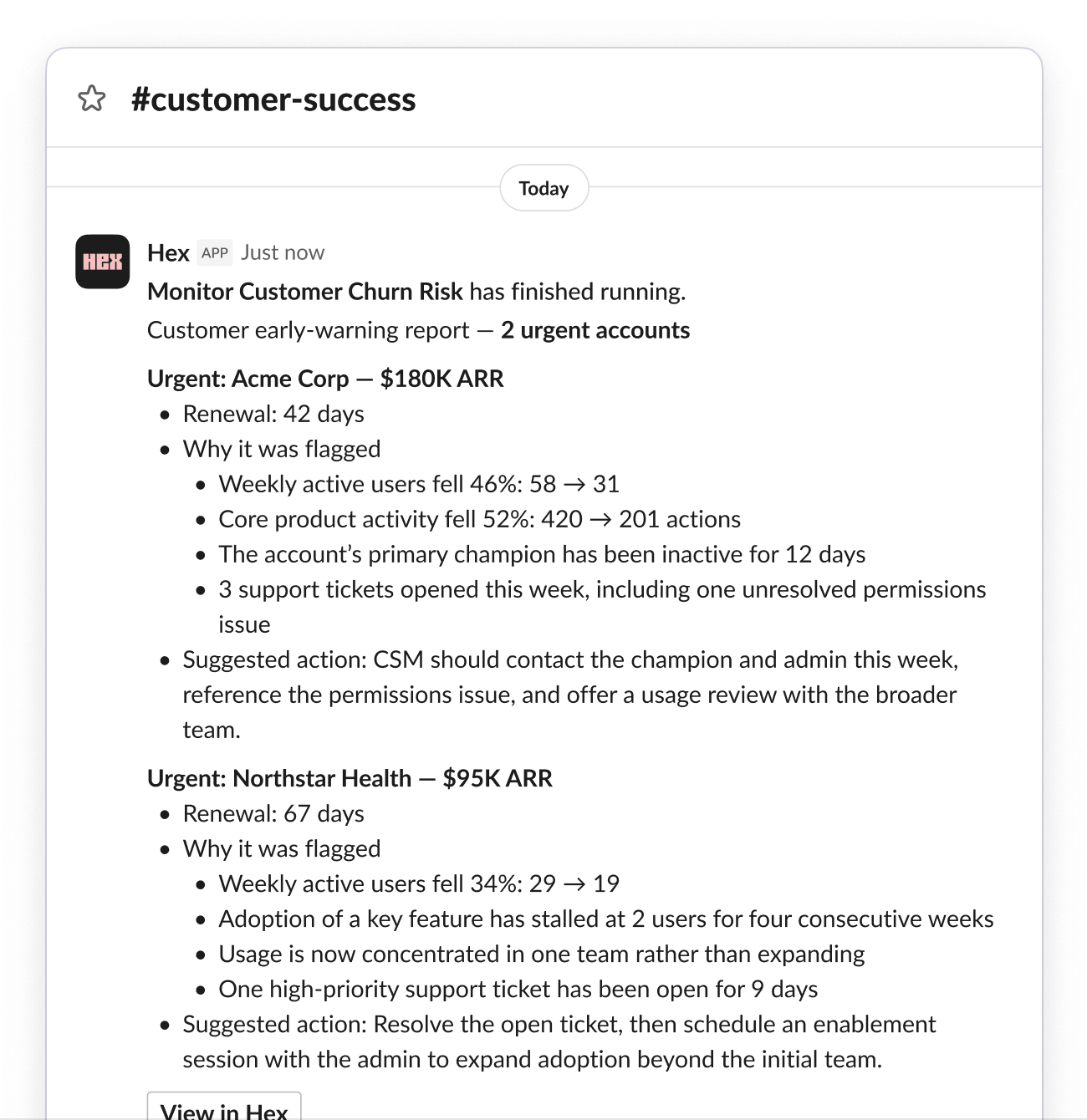
Know when a customer goes quiet, before it affects your forecast
Set up Tasks to watch for engagement drops, ticket spikes, feature adoption stalls and get the alert in Slack, or wherever you work, before the account goes cold.
$1M
saved in churn by building a multi-dimensional churn prediction app in Hex.
"What really matters is taking these ad hoc insights and operationalizing them. Traditional BI tools are built for the purpose of limiting scope. You don’t want those dashboards to have so much data that people don’t know what they’re looking for."

Where to start
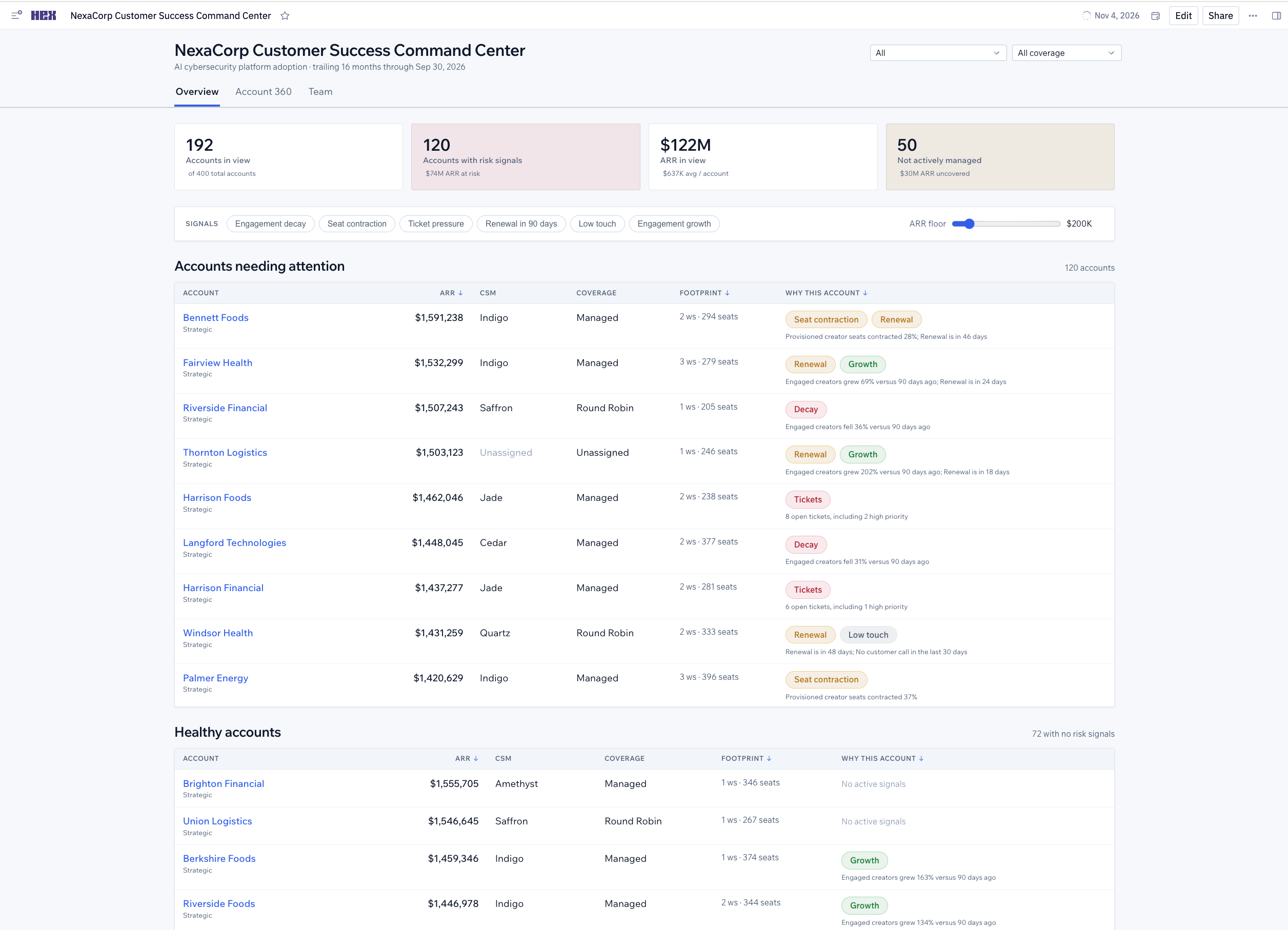


Account 360 is dead. Long live Account 360.
Why Hex’s customer team replaced its Account 360 dashboard with Threads.
Learn why customer teams choose Hex
FAQ
Yes, once that data is in your warehouse. Hex connects to databases and warehouses like Snowflake, BigQuery, Databricks, Redshift, and Postgres, not directly to Salesforce, HubSpot, Zendesk, or Intercom. Most teams sync those tools into the warehouse first. Hex then joins CRM, ticket, and usage data into one account view that CSMs and the data team explore together.
Partly. A Hex QBR app can refresh on a schedule and send results to CSMs by email or Slack, as a PNG/PDF snapshot, CSV, or straight to Google Sheets. Hex doesn't create Google Slides or PowerPoint decks, so CSMs still paste charts into their own slides. It removes the slow part: pulling and checking the data.
Yes. CSMs can ask the Hex Agent in plain English, like "Which of my accounts had usage drop last month?", and get answers and charts built on semantic models and data the data team has endorsed. They can also chat with published dashboards, or ask the Hex Agent in Slack.
Yes, with conditional notifications. A Hex app refreshes on a schedule, and when a condition you set is met (say, weekly active users fall below a threshold), Hex notifies chosen people or a Slack channel. Hex doesn't predict churn on its own; your team defines the signals or health-score logic, and Hex checks it on every refresh.
No. Hex is the analytics layer on top of your CS stack, not a system of record. Gainsight, your CRM, and your support tools still run playbooks, tasks, and account records. Hex analyzes the data those tools create alongside product usage in your warehouse, for deeper health analysis, churn investigations, and custom views CS platforms find hard to build.
With semantic models: shared definitions of metrics like churn rate or health score that the data team writes once and everyone reuses. The Hex Agent prioritizes semantic models and endorsed data, so answers follow approved definitions. Teams can also bring in existing dbt definitions, and guides tell the agent which version of "churn" (e.g. rolling 12-month) is standard.
Not directly. Hex has no built-in connector that writes to Salesforce, but it can write results like a health score table back to your warehouse. A reverse-ETL tool can then sync those scores into Salesforce fields. Hex can also send scores to Google Sheets or Slack on a schedule.