
FOR SALES TEAMS
Forecasting gets better when it's built on data
From SDRs to Sales Leads, give everyone the confidence to be a data person.
Used by data-driven revenue teams

"With Hex’s Notebook Agent, I never have to build another chart again? What a dream come true."
Rie McGiwer and Molly Jane Nicholas AI Insights Researcher and Senior Researcher

"Most data teams are stuck answering ad hoc questions. Hex flipped that for us. Now the business answers its own questions, and I focus on building systems that scale."
Kenny Ning and David Dorman Head of Data and VP of Marketing and Growth

"We like to embed Hex dashboards where teams work."
Ian Macomber Head of Data and Analytics Engineering


"I wrote zero SQL by hand, absolutely zero. Hex is the single most useful and magical tool that has ever existed to make my job better in 20 years."
Tim Frietas Product Manager



Build a forecast that keeps pace with your business
See what it will take to hit your target
Model your pipeline with historical conversion rates and sales cycle timing with Hex. Adjust assumptions to see where to focus and what could change the outcome.
"We’ve seen our VP of sales ops getting into Hex, doing some stuff that would have taken a deep Python background to do in his free time, wearing his pajamas. Which is pretty unbelievable."

Get to the why behind your numbers
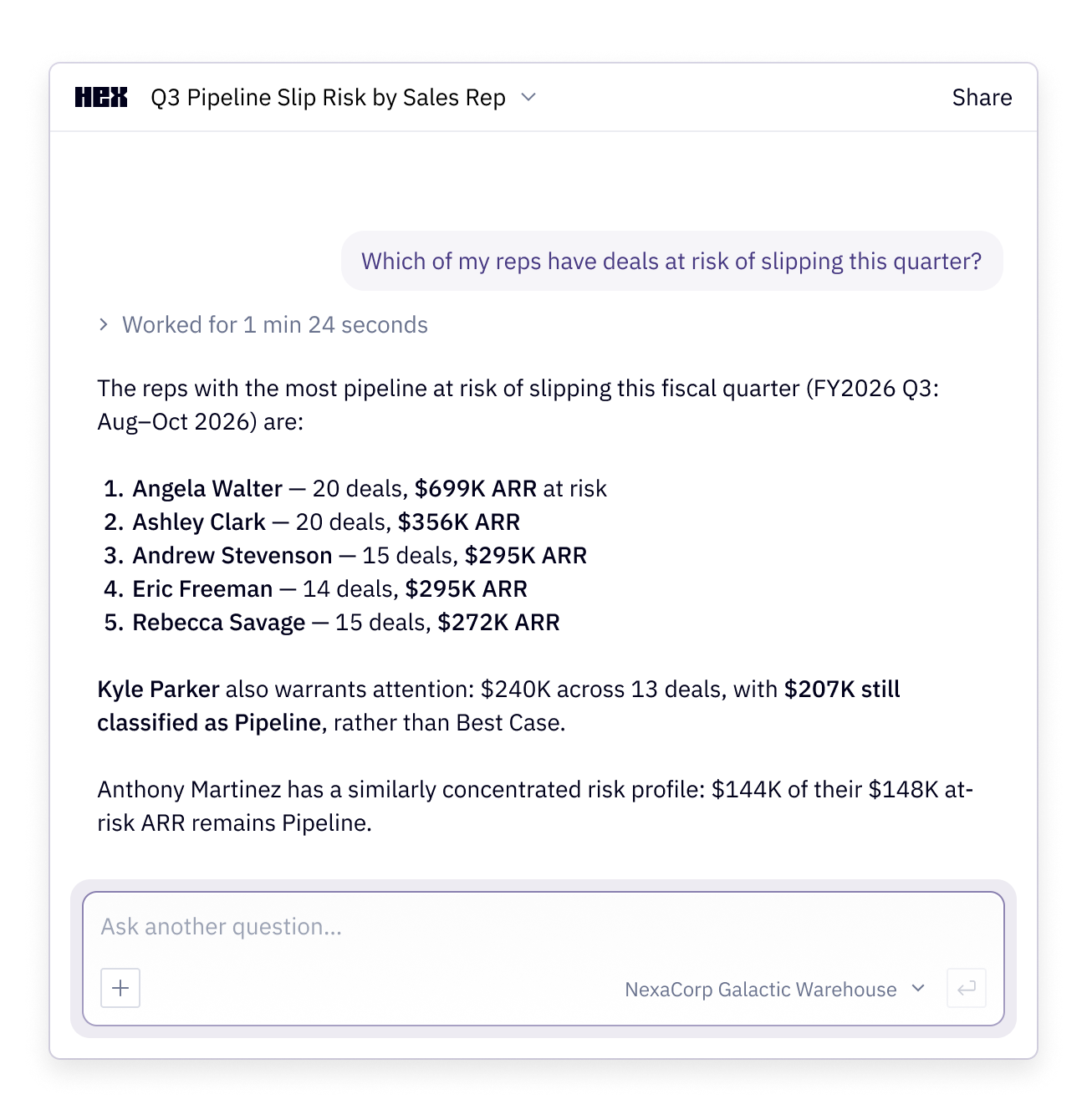
Start with a question, then keep digging
Explore deals, segments, and rep performance in your own words without another data request.
"Hex’s agent helped me build reporting to know exactly where to plug in for my team. A rep can look on track on the surface, but Hex shows me the full picture — win rates, deal velocity, stage timing — so I can step in at the right moment. That's how we're exceeding quota."

Stay ahead of deal risk
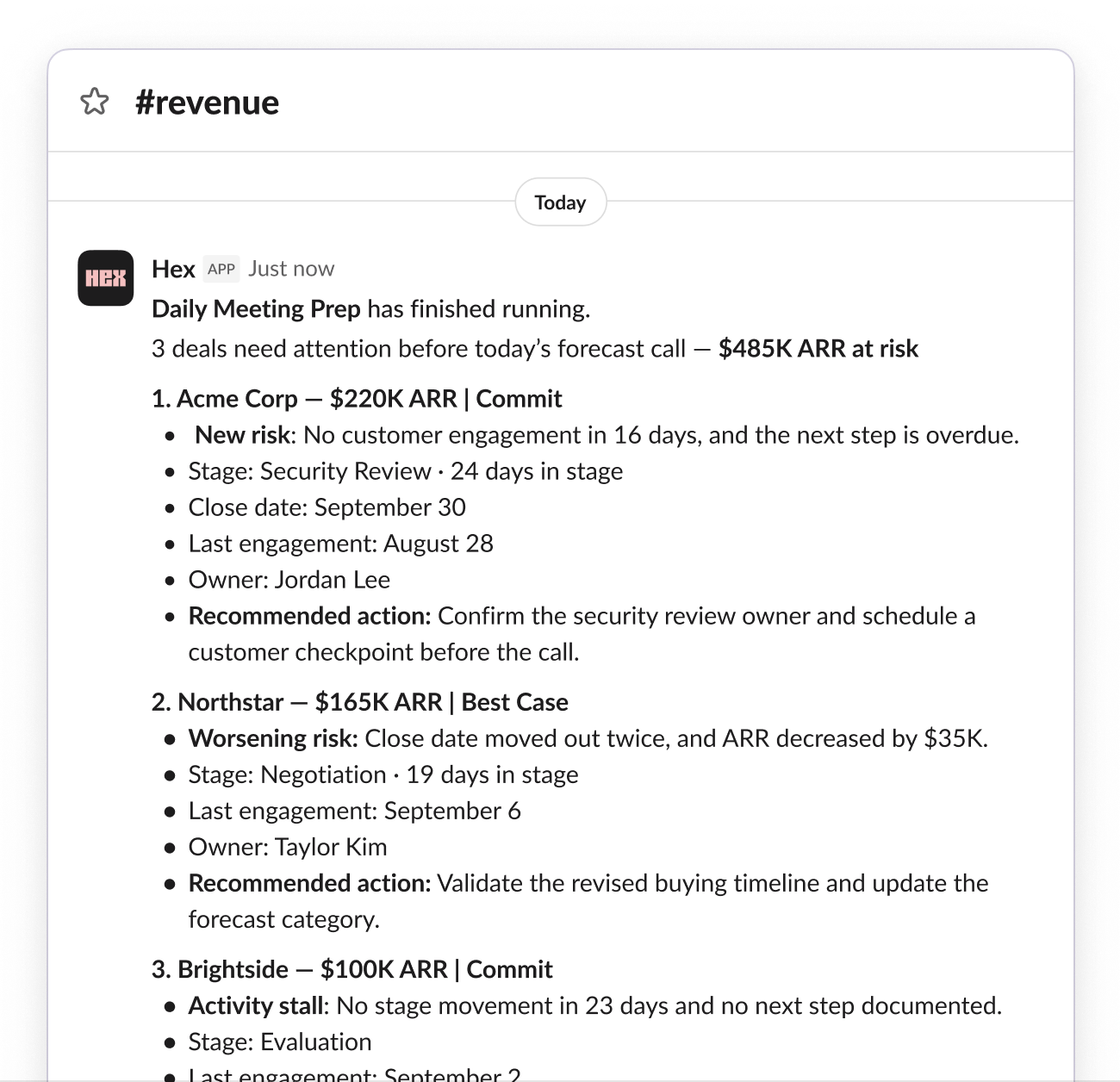
Walk into every forecast ready with a plan
Set Tasks to watch for deal velocity drops, engagement gaps, and activity stalls, and get the alert in Slack before the call, not during it.
"We embed Hex dashboards where teams already work — Salesforce, Notion, and beyond — enabling analytics engineers to build ML-level data products like sentiment analysis and shrinking feedback loops from days to hours."
Where to start
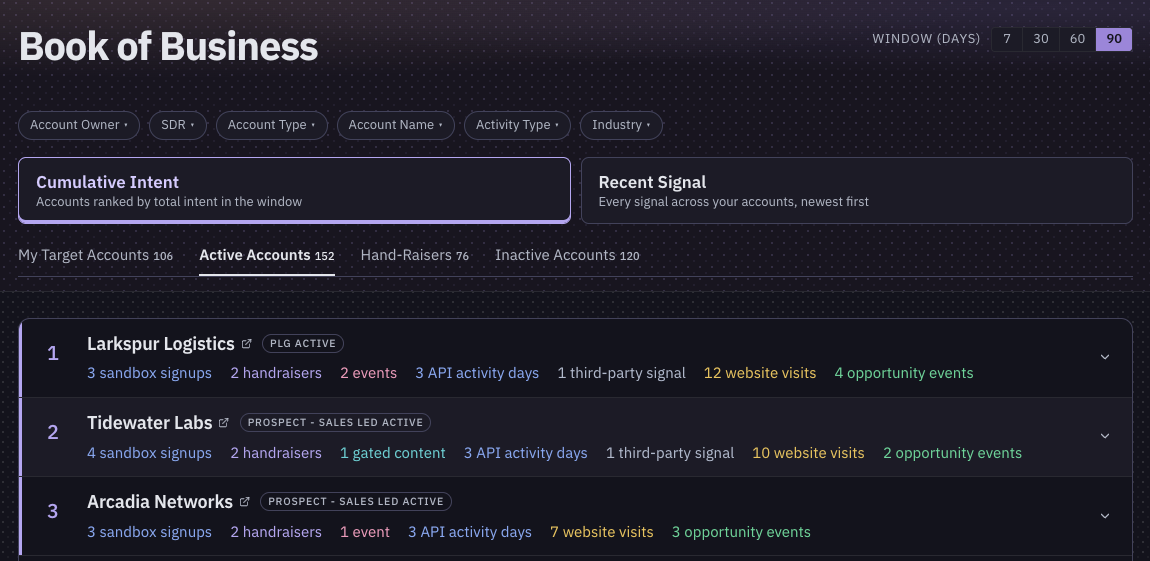
Sales Account Prioritization Tool
Rank accounts by product, web, and campaign signals so reps know who to call first.
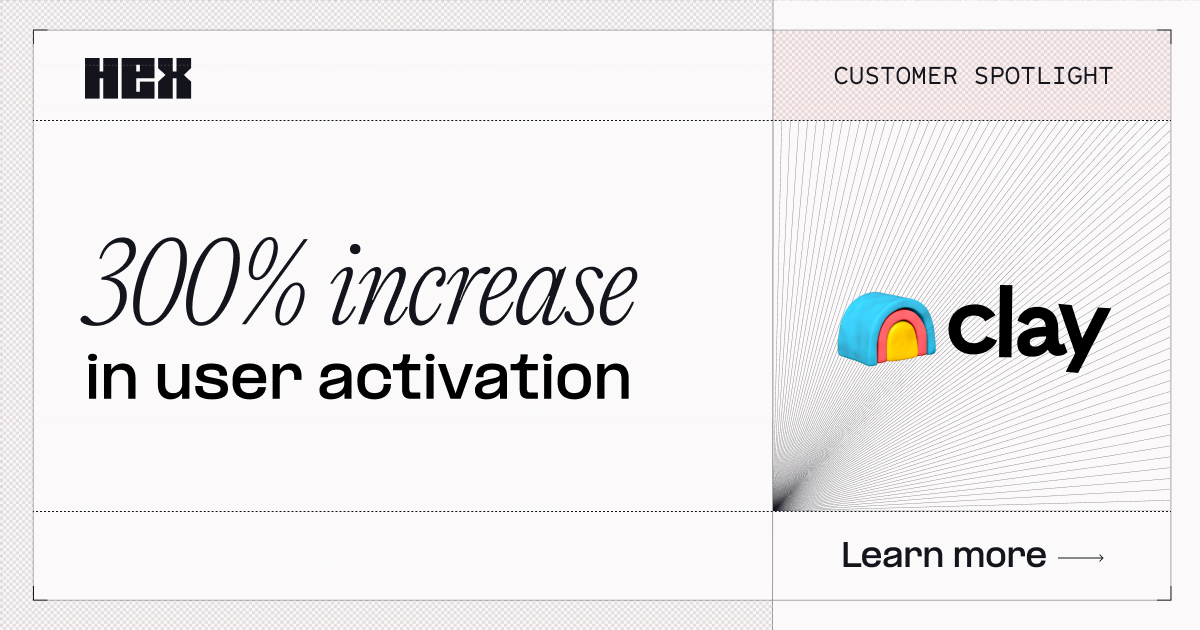
Clay cut SLAs by 80%
Clay used Hex to give their sales team the pipeline visibility to close their best quarter on record.
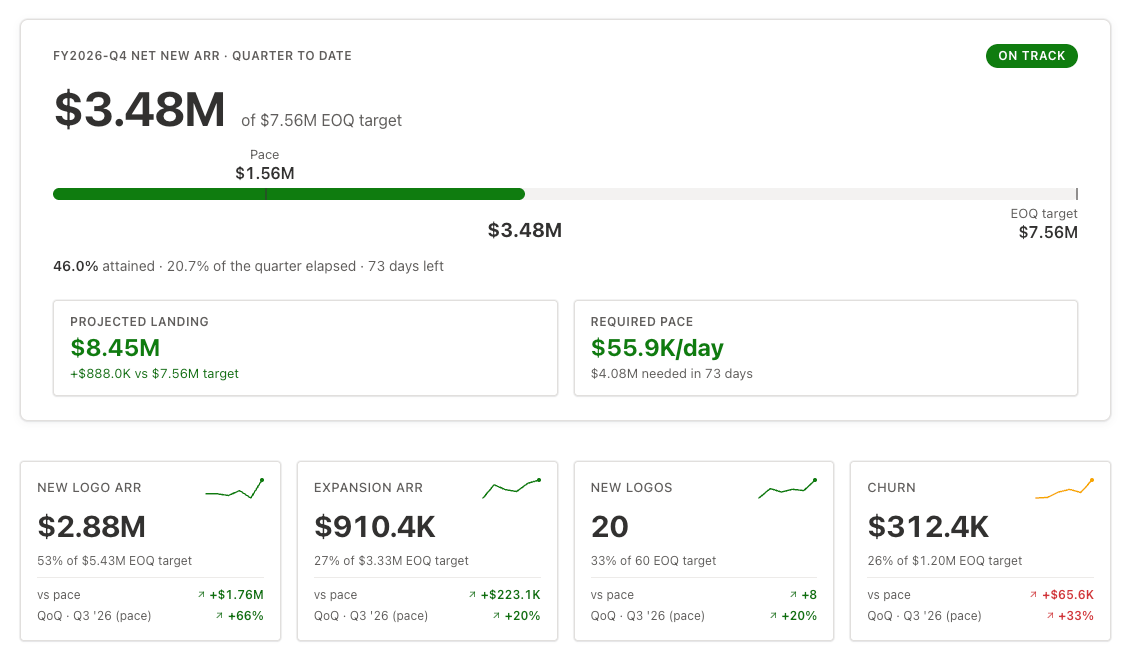
Revenue Leader Forecast
How Hex’s own team pulled every lead signal into one prioritized view and lifted inbound conversion 54%.
Mercor unlocked $100M in revenue
Mercor scaled from zero to $100M in revenue with operational and revenue analytics — delivering dashboards across hundreds of customer projects with Hex Agent.
Learn why data teams choose Hex for sales analytics
FAQ
No. Hex connects to databases and data warehouses such as Snowflake, BigQuery, Databricks, Redshift, and PostgreSQL. Most teams sync CRM data into the warehouse with an ingestion tool, then analyze it in Hex. That way pipeline data sits alongside product usage, billing, and marketing data instead of staying stuck in the CRM.
Through semantic models: shared definitions of metrics, dimensions, and table relationships that the data team maintains, so "ARR" or "pipeline" means the same thing everywhere. Teams can build them in Hex or sync existing definitions from dbt MetricFlow, Cube, or Snowflake Semantic Views. The Hex Agent prioritizes these models and endorsed data, so answers follow the governed definitions.
Yes. The data team can build a custom pipeline forecast in SQL and Python, such as a weighted-pipeline, stage-conversion, or statistical model, and publish it as an interactive app where sales leaders adjust the assumptions. Hex doesn't include a ready-made forecasting product with rep submissions or roll-ups. It's where you build forecasts on your own definitions.
Yes. Sales leaders can ask the Hex Agent questions like "How much pipeline do we need in Q1 to hit target?" and get answers built on the semantic models and endorsed data RevOps maintains. They can also chat with any published app, in Hex or through the Hex Agent in Slack. RevOps still owns the definitions that keep answers reliable.
Not exactly. Hex isn't a revenue-intelligence or forecast-submission tool, and Salesforce stays your system of record. Hex replaces the spreadsheets, one-off exports, and duplicate CRM reports teams use for deeper pipeline analysis. The data team builds governed analysis that combines CRM with product, billing, and marketing data, and sales leaders explore it themselves.
Yes, if your team defines what "at risk" means. The data team builds logic for signals like stalled stage age, pushed close dates, or low engagement, and schedules the app to run before the forecast call. Conditional notifications alert people only when a condition is met. Tasks can also send a recurring summary from the Hex Agent to Slack.
Yes, if your warehouse stores historical pipeline snapshots. Most CRMs overwrite deal stage and amount when they change, so point-in-time views need daily snapshots or field-history tables, often built with dbt. With that history in place, Hex can compare start-of-quarter pipeline to today. Without it, Hex can only show each deal's current state.