
Beyond “insights”
If you read a lot of data content (perhaps especially from vendors like us!) you’ve heard a lot about “insights” — these mythical, mystical artifacts held out as the currency of value for data teams.
And yeah, insights are important. Accurate accountings of what’s true about the world are valuable and good, and there are skills and tools that can help you generate them. But it’s always felt like a very reductive way to view the role of a data team – something is missing.
Pedram’s recent post, “It’s not enough to be right” (and our live conversation about it!) clicked something into place for me; it’s that insights themselves are just one dimension, but the other more important one is agency.
In fact – like all good business concepts – this can be expressed on a two-by-two, with accuracy and effectiveness on each side:
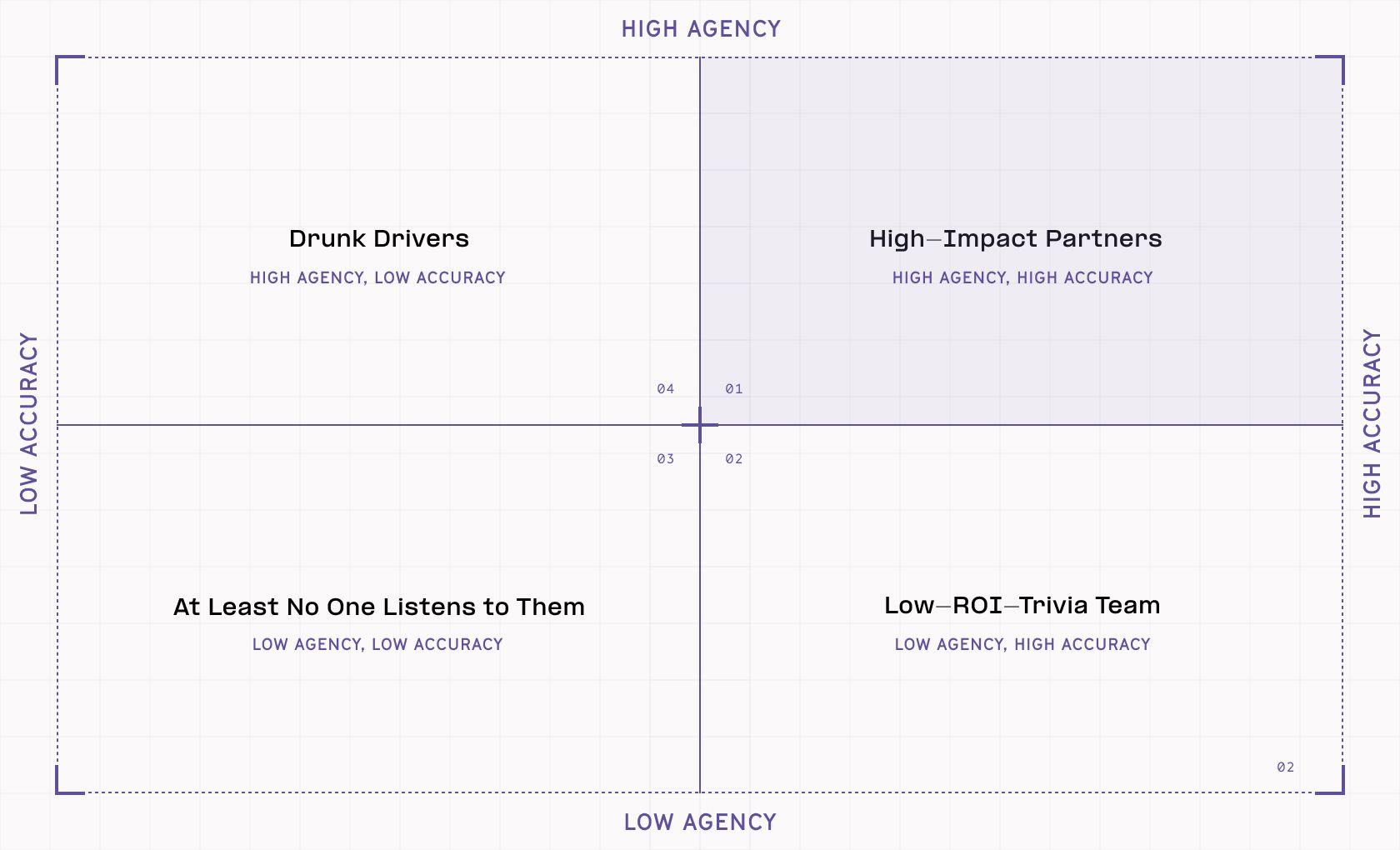
In each quadrant we have distinct flavors of data teams, in descending order of value:
- The “High-Impact Partners” - high accuracy and high agency, the holy grail. These folks are showing up with the right insights at the right time and things are changing because of it.
- The “Low-ROI-Trivia Team” – high accuracy but low agency, which is fine but likely to still feel unimpactful. These folks are full of facts, but stakeholders don’t necessarily feel they’re useful.
- The “At Least No One Listens to Them” – low accuracy and low-agency, this is low damage but a waste of money. I often find these to be the Ivory-tower data teams who are so unattached from the fiber of the business that whether they’re right or wrong never really matters.
- The “Drunk Drivers” – low accuracy and high agency, this is probably the worst.
I suspect most data teams think they’re either 1 or 2; unfortunately many are 3 or 4 and don’t realize it (or don’t know what to do about it).
What does it look like to be high agency?
Winning friends and influencing people
My personal definition of the word “analytics” is “data work meant to influence a decision” — but a lot of data folks think about the first part and not the second. The reality is that the hardest part of making your work matter might not be the work itself – it might be the presentation, socialization, and persuasion.
Pedram frames this as “politics” and yeah — it sort of is! The ability to understand your constituency, craft arguments, and wield influence are intangible “soft” skills that only occasionally correlate with analytical skill.
If you’re struggling with agency but also think that it’s someone else’s job to figure out how your insights get translated into action, you may need to re-evaluate and figure out how to reset your expectations.
Cycle time
An unappreciated aspect is speed — if you’re right, but show up with the answer after everyone has moved on, it doesn’t matter.
This ability to go from question to accurate answer — quickly — is a hallmark of high-agency data teams. Sometimes this means compromising on absolute accuracy, and getting something directionally right in front of stakeholders.
That can be hard for the more perfectionist among us to do, but I believe this kind of pragmatism is a key factor to agency in any domain, including data.
Digging in the dirt
Finally, perhaps the most common failure mode in low-agency data teams is the “ivory tower.” Too many data professionals sit removed from the substance of the business, and aren’t in the trenches with the folks actually making decisions.
At Hex, I’m really happy with how deeply embedded our data team is — we have analytics engineers and analysts in revenue forecast meetings, product planning sessions, and other critical points of connection across the company.
This means they have a clear understanding and line-of-sight to the decisions that are being made, and don’t need to go through some separate delegation process to figure out what’s going to be most valuable — and therefore highest-impact.
Agents will have low agency
A final thought: among the last things AI is likely to be good at are building trusted relationships and influence among stakeholders. We may think that a sufficiently advanced AI “agent” can simulate this, but I still don’t think people want an AI data scientist.
This is one reason I remain bullish on data as a profession in the AI era – so much of what makes an effective analyst or data scientist has nothing to do with memorizing Pandas syntax.
In this way, the human delivery mechanism – bundling context, charisma, and accountability – is going to be just as important as ever. In fact, if you believe as we do that AI can speed cycle time and lower the cost of getting accurate answers, we may need more – not less – data people who can figure out how to impact the business with those insights.
If this is is interesting, click below to get started, or to check out opportunities to join our team.