Make everyone a data person

Hex makes it easy for everyone to ask questions and build with data, without all the chaos, cost, and confusion.

Agentic data notebooks
data-sources
packages
files
variables
scheduled-runs
history
SQL cell
quarterproduct_lineregioncustomer_sectorrevenue_usd
0Q3-2025Teleportation padsCore WorldsDefense18200000
1Q3-2025Quantum drivesCore WorldsDefense16500000
2Q3-2025Wormhole initiatorsCore WorldsDefense14800000
Revenue Trends by Product Line (Q1-Q3)
50
40
30
20
10
0
Q1
Q2
Q3
Python cell
Account Revenue vs Growth (Q3)
25
20
15
10
5
0
0
10
20
30
40
50
Python cell
Galactic Revenue Distribution by Product Line (Q3)
Teleportation pads
Quantum drives
Wormhole initiators
Dark matter lasers
Temporal stabilizers
Anti-gravity generators
0%
20%
40%
60%
80%
100%
Python cell
Sector Revenue Mix by Product Line (Q3)
Teleportation pads
Quantum drives
Wormhole initiators
Dark matter lasers
Temporal stabilizers
Anti-gravity generators
0
20%
40%
60%
80%
100%
magicAgent
History
/NexaCorp Revenue Insights
plus
close-small
Get me NexaCorp's Q3 sales by product line
I'll help you analyze NexaCorp's revenue by product line. I'll pull data from Q1-Q3 so you can compare trends over the last few quarters and see how Q3 fits into the broader pattern.
chevron-downThought for 23 seconds

NexaCorp revenue trends by product line

Here's what I found in the "nexacorp_sales" tables (powered by the Galactic Sales semantic model):

  • Teleportation pads$42.3M
  • Quantum drives$38.7M
  • Wormhole initiators$33.1M
  • Dark matter lasers$28.6M
  • Temporal stabilizers$21.8M
  • Anti-gravity generators$11.2M
chart
Created Revenue by Product Line Over Time (Q1-Q3)
chart
Created Account Revenue vs Growth (Q3)
I also created a chart showing revenue vs growth. Let me know if you'd like to break this down by region or customer sector.
Can you break this out by region too? I want to see how each product line performed across the Core Worlds, Mid-Rim, and Outer Rim.
I'll help you analyze NexaCorp's Q3 revenue by product line and region. Let me search for the most relevant data source.
chevron-downThought for 11 seconds
I found regional revenue data in the endorsed semantic model "NexaCorp: Galactic Sales Model." This model contains standardized region definitions (Core Worlds, Mid-Rim, Outer Rim) and pre-calculated revenue metrics, which is the best source for your question.

Let me create a grouped bar chart so you can compare regions within each product line:
chart
Created Galactic Revenue Distribution by Product Line (Q3)
Quick insight: Core Worlds lead revenue for Teleportation pads and Quantum drives, while Wormhole initiators see a stronger mix from the Outer Rim.
Can you also show how revenue breaks down by customer sector?
I'll help you analyze NexaCorp's Q3 revenue by product line and customer sector. Let me search for the most relevant data source.
chevron-downThought for 17 seconds
I found customer sector data in the same NexaCorp: Galactic Sales Model. This includes standardized sector definitions (Defense, Commercial, Research, Government) and pre-calculated revenue metrics.

Let me compute the sector mix for each product line so you can compare buyer patterns.
chart
Created Sector Revenue Mix by Product Line (Q3)
Quick insight: Defense drives most high-value product-line revenue, while Research over-indexes for Anti-gravity generators and Wormhole initiators.
plus
NexaCorp Galactic Warehousechevron-down
enter
Conversational self-serve
Get me NexaCorp's Q3 sales by product line
I'll help you analyze NexaCorp's revenue by product line. I'll pull data from Q1-Q3 so you can compare trends over the last few quarters and see how Q3 fits into the broader pattern.
chevron-downThought for 23 seconds

NexaCorp revenue trends by product line

Here's what I found in the "nexacorp_sales" tables (powered by the Galactic Sales semantic model):

  • Teleportation pads$42.3M
  • Quantum drives$38.7M
  • Wormhole initiators$33.1M
  • Dark matter lasers$28.6M
  • Temporal stabilizers$21.8M
  • Anti-gravity generators$11.2M
Revenue by Product Line Over Time (Q1-Q3)
exploreExplore
50
40
30
20
10
0
Q1
Q2
Q3
Account Revenue vs Growth (Q3)
exploreExplore
25
20
15
10
5
0
0
10
20
30
40
50
I also created a chart showing revenue vs growth. Let me know if you'd like to break this down by region or customer sector.
Can you break this out by region too? I want to see how each product line performed across the Core Worlds, Mid-Rim, and Outer Rim.
I'll help you analyze NexaCorp's Q3 revenue by product line and region. Let me search for the most relevant data source.
chevron-downThought for 11 seconds
I found regional revenue data in the endorsed semantic model "NexaCorp: Galactic Sales Model." This model contains standardized region definitions (Core Worlds, Mid-Rim, Outer Rim) and pre-calculated revenue metrics, which is the best source for your question.

Let me create a grouped bar chart so you can compare regions within each product line:
Galactic Revenue Distribution by Product Line (Q3)
exploreExplore
Teleportation pads
Quantum drives
Wormhole initiators
Dark matter lasers
Temporal stabilizers
Anti-gravity generators
0%
20%
40%
60%
80%
100%
Quick insight: Core Worlds lead revenue for Teleportation pads and Quantum drives, while Wormhole initiators see a stronger mix from the Outer Rim.
plus
NexaCorp Galactic Warehousechevron-down
enter
Beautiful data apps
Summary
Regions
Customer Sectors
Product Lines
$175.7M
Total Q3 Revenue
9.7% vs last quarter
Mid-Rim
Top Growth Region
4.1% vs last quarter
Commercial
Highest Revenue Sector
3.0% vs last quarter
Product Line
All
chevron-down
All product lines
Teleportation pads
Quantum drives
Wormhole initiators
Dark matter lasers
Temporal stabilizers
Anti-gravity generators
Region
All
chevron-down
All regions
Core Worlds
Mid-Rim
Outer Rim
Customer Sector
All
chevron-down
All customer sectors
Defense
Commercial
Research
Government
Quarter
Q3
chevron-down
All quarters
Q1
Q2
Q3
exploreExplore
Revenue by Product Line Over Time (Q1-Q3)
50
40
30
20
10
0
Q1
Q2
Q3
exploreExplore
Account Revenue vs Growth by Product Line
25
20
15
10
5
0
0
10
20
30
40
50
exploreExplore
Revenue Mix by Customer Sector
Teleportation pads
Quantum drives
Wormhole initiators
Dark matter lasers
Temporal stabilizers
Anti-gravity generators
0
20%
40%
60%
80%
100%
magicAgent
History
/New thread
plus
close-small
How did Commercial revenue perform in the Mid-Rim in Q3?
I’ll update the app to focus on that.
chevron-downThought for 17 seconds
  • Customer Sector → Commercial
  • Region → Mid-Rim

With those filters applied, the Revenue by Product Line Over Time (Q1–Q3) chart shows Commercial revenue in the Mid-Rim increasing through Q3, ending the quarter at its highest point in the time range.

You can switch Product Line to isolate what’s driving that growth, or change Quarter to compare against earlier periods.

plus
enter
Semantic
models
Rules &
guides
Endorsed
tables
Organization
context
Existing
analysis
Database
metadata
Suggestions

Use Hex from anywhere

Breaking the tradeoff between AI analytics, and trust

Everyone’s using AI now… and it’s a mess. Random chat apps, rogue dashboards, vibe-coded HTML files, loose spreadsheets, inconsistent answers, and lots of risk – and it’s just getting worse.

Hex is built from the ground-up for agents – with a full suite of tools you need to unlock your team’s curiosity, while maintaining trust and governance.

Get trusted answers from agents, anywhere

Hex’s powerful agent unlocks true self-serve, by grounding answers in your context.

And Hex works with your other apps, too, with first-class connectors to Claude, Codex, Cursor, Slack, MCP, a CLI, APIs, or custom agents.

Explore self-serve insights
quote

"Hex has great visual and design sensibility. The ability to use Hex in any way we choose is valuable because now we can connect into Hex via my favorite dev tools."

LangChain
Nithin Bose. VP of Customer Engineering
Chat with the Hex Agent
Get me NexaCorp's Q3 sales by product line
I'll help you analyze NexaCorp's revenue by product line. I'll pull data from Q1-Q3 so you can compare trends over the last few quarters and see how Q3 fits into the broader pattern.
chevron-downThought for 23 seconds

NexaCorp revenue trends by product line

Here's what I found in the "nexacorp_sales" tables (powered by the Galactic Sales semantic model):

  • Teleportation pads$42.3M
  • Quantum drives$38.7M
  • Wormhole initiators$33.1M
  • Dark matter lasers$28.6M
  • Temporal stabilizers$21.8M
  • Anti-gravity generators$11.2M
Revenue by Product Line Over Time (Q1-Q3)
exploreExplore
50
40
30
20
10
0
Q1
Q2
Q3
Account Revenue vs Growth (Q3)
exploreExplore
25
20
15
10
5
0
0
10
20
30
40
50
I also created a chart showing revenue vs growth. Let me know if you'd like to break this down by region or customer sector.
Can you break this out by region too? I want to see how each product line performed across the Core Worlds, Mid-Rim, and Outer Rim.
I'll help you analyze NexaCorp's Q3 revenue by product line and region. Let me search for the most relevant data source.
chevron-downThought for 11 seconds
I found regional revenue data in the endorsed semantic model "NexaCorp: Galactic Sales Model." This model contains standardized region definitions (Core Worlds, Mid-Rim, Outer Rim) and pre-calculated revenue metrics, which is the best source for your question.

Let me create a grouped bar chart so you can compare regions within each product line:
Galactic Revenue Distribution by Product Line (Q3)
exploreExplore
Teleportation pads
Quantum drives
Wormhole initiators
Dark matter lasers
Temporal stabilizers
Anti-gravity generators
0%
20%
40%
60%
80%
100%
Quick insight: Core Worlds lead revenue for Teleportation pads and Quantum drives, while Wormhole initiators see a stronger mix from the Outer Rim.
plus
NexaCorp Galactic Warehousechevron-down
enter
Show NexaCorp Q3 sales

Hex get me NexaCorp’s Q3 sales by product line

Worked for 27s
Search projects

NexaCorp Q3 sales by product line

Here’s what I found in the “nexacorp_sales” tables:

  • Teleportation field extenders — $42.3M
  • Quantum drives — $38.7M
  • Wormhole initiators — $33.1M
Slack
Avatar
@Hex get me NexaCorp's Q3 sales by product line
3 replies
Your question was sent to Hex! The answer will be posted here, but you can also follow along in Hex.
View in Hex

NexaCorp Q3 revenue trends by product line

Here's what I found in the “nexacorp_sales” tables (powered by the Galactic Sales semantic model):

  • Teleportation pads $42.3M
  • Quantum drives $38.7M
  • Wormhole initiators $33.1M
  • Dark matter lasers $28.6M
  • Temporal stabilizers $21.8M
  • Anti-gravity generators $11.2M
Revenue Trends by Product Line (Q1-Q3) (56 kB)
50
40
30
20
10
0
Q1
Q2
Q3
Let me know if you'd like to break this down by region or customer sector.
Hex CLI

From a prompt to data apps, dashboards, or… almost anything

With a prompt, anyone can build a data application – and Hex’s powerful platform provides the guides and guardrails to make sure they work and look the way they should.

Under the hood it’s all code – but with the last-mile controls and polish you expect.

Explore AI app building
quote

"With Hex's Notebook Agent, I never have to build another chart again? What a dream come true."

Figma
Molly Jane Nicholas. Senior Researcher
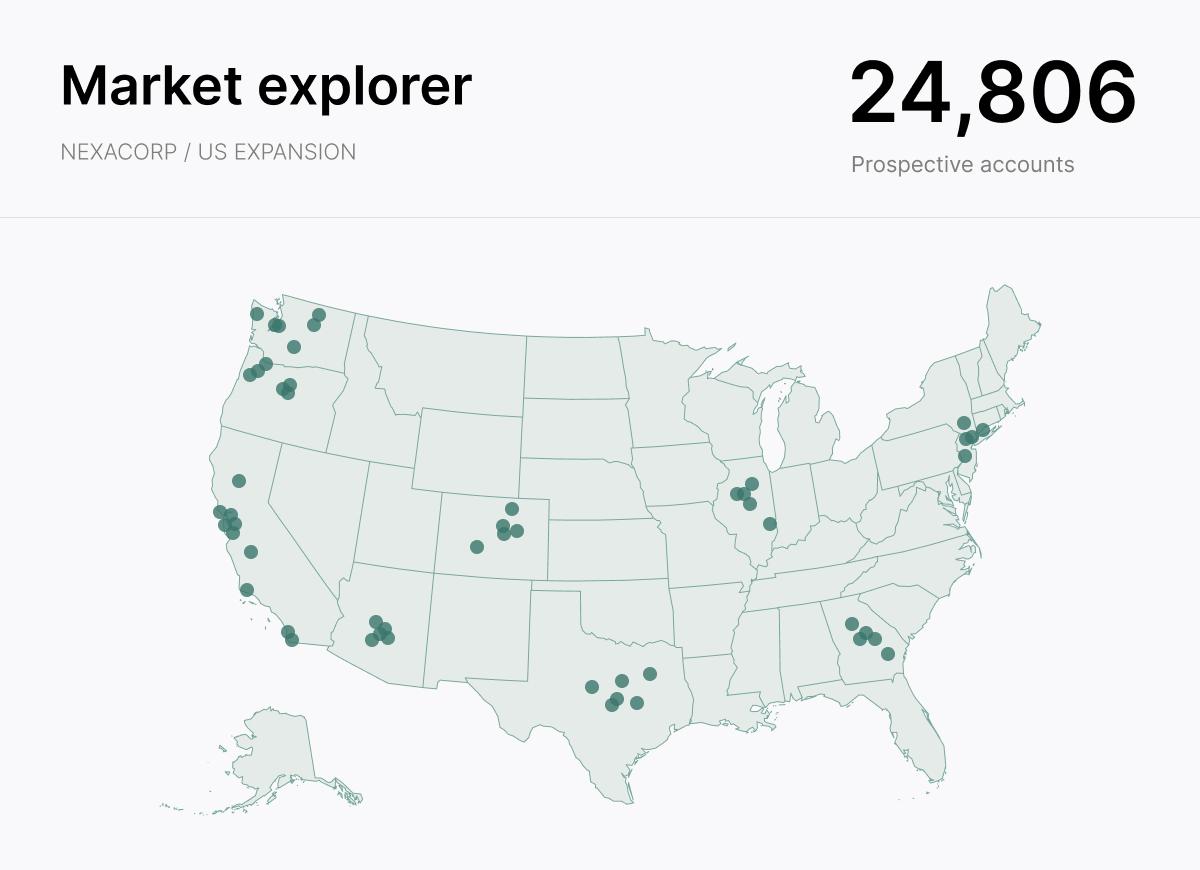
Market explorer map of 24,806 prospective US accounts as clustered dots
Explore customer demand across the US
NexaCorp subscription revenue line chart at $550k, down 8.4% from April to September
Track revenue across the business
NexaCorp Q4 pricing forecast of $428k projected revenue with a dashed line after today
See next quarter’s revenue forecast
NexaCorp customer portfolio table of 283 accounts with ARR and usage change
Keep an eye on customer accounts

A context platform that gets smarter the more you use it

Hex learns automatically, creating a compounding loop of trust and accuracy. You can create, sync, and manage semantic models, guides, and skills – and then observe how they’re being used.

Explore the Context Engine

Intelligent observability, so you know if people are actually getting good answers

Everyone’s asking questions – but are they getting good answers?

Hex’s Context Studio and Evals give you unprecedented visibility, allowing you to see topics, trends, and warnings where things are going off the rails.

Explore the Context Studio and Evals
quote

"We have so many people and products that our context is never stagnant. Even when we launch a new data domain for the first time, it's already stale the next day. Hex’s Context Studio and Evals give us the visibility needed to manage our context at scale."

Chime
Jordan Farrer. Director of Data Science & Analytics
Evals

Q3 Enterprise Launch Readiness

3 passed2 failed
GradePromptAttemptsRubricsAverage timeTotal credits
PassedHow much ARR do we have from currently active customers?Passed1/1356s8.6
RubricAttempt 1 Passed

Numeric target: SQL ground truth

Numeric value
Passed
Reported: 26683729
Expected: 26683729 (SQL result)

Did the agent source ARR from dim_customers.total_arr (the canonical point-in-time ARR source) joined to dim_accounts for the account status - rather than deriving ARR from opportunity amounts, targets, or any other table?

Thread judge
Passed

The agent returned $26,683,729 using dim_customers.total_arr joined to dim_accounts and filtered on account_status = 'Active'.

Did the agent apply the correct definition of "active" - the account lifecycle status flag (dim_accounts.account_status = 'Active') - rather than a product-usage, login-based, or invented definition?

Thread judge
Passed

The agent summed dim_customers.total_arr for records joined to accounts where dim_accounts.account_status = 'Active', returning $26,683,729.

52s agent 4.6s judge 8.6 credits
PassedWhich features are included in the NexaCorp Enterprise launch?PassedPassedPassed3/3341.8s9.2
FailedWhat migration discounts are available for existing NexaCorp customers?PassedFailedFailed1/3238.6s7.4
FailedWhich connectors are generally available on launch day?PassedPassedFailed2/3233.2s7.0
PassedSummarize the Q3 Enterprise messaging for SalesPassedPassedPassed3/3347.9s9.5
Agent observability
Observability
trendingOverview
Management
lightbulbSuggestions
endorsedEndorsements
libraryGuides
semantic-modelsModels
sharingConnections
groupsAll roles
chevron-down
All roles
Admin
Editor
Explorer
userAll users
chevron-down
All users
Kira Vance
Marcus Sol
Vega Chen
Orion Reyes
Nova Okafor
Cass Meridian
libraryAll topics
chevron-down
All topics
Revenue by Product Line
Sales Breakdown
Sector Analysis
Quarterly Trends
Product Comparisons
Sector Revenue
successAll warnings
chevron-down
All warnings
User doubt
Missing context
globeAll sources
chevron-down
All sources
Hex
Slack
MCP
CLI
Last 7 days
chevron-down
Last 7 days
Last 30 days
Last 60 days
Custom range
Agent conversations
461
Unique users
55
Warnings
12
Conversation volume
500
400
300
200
100
0
9/19
9/20
9/21
9/22
9/23
9/24
Top conversation topics
Revenue by Product Line
Sales Breakdown
Sector Analysis
Quarterly Trends
Product Comparisons
Sector Revenue
0
5
10
15
20
25
30
35
DATEAGENTPROMPTTOPICWARNINGSSOURCEUSERROLE
44 min agoNotebookHow did revenue change across the Outer Rim compared to last quarter?Revenue by Product LineHexLuc PattonAdmin
1 hr agoThreadsWhich product lines saw the strongest Research-sector demand?Sales BreakdownUser doubtSlackEels GulsenEditor
2 hrs agoModelingHelp me define measures and dimensions for the Core Worlds semantic model.Sector AnalysisMCPAndrei LeesomExplorer
3 hrs agoThreadsGive me a breakdown of negative customer feedback in the Outer Rim this month.Sector RevenueMissing contextCLIAndrei LeesomExplorer
3 hrs agoThreadsWhat are this quarter's top customer pain points in the Outer Rim?Quarterly TrendsHexAndrei LeesomExplorer
Self-learning

Setting up context is one thing, but managing changes can be a headache

Hex generates automated suggestions and improvements drawn from the questions people are really asking, so answers get better the more people use it.

Learn more about Suggestions
Easy to set up

Building context shouldn’t have to take months

Instead of forcing you to build models before you can even start, Hex pulls from the existing semantic models, database definitions, and documentation you already have.

Discover semantic model sync
Flexible by design

Get a handle on your token spend, and avoid model lock-in

Your AI bill is getting big – but you don’t know who is spending how much on what things, and whether they’re actually valuable.

Hex helps you get control of this:

  • Model choice, including open source models

  • Thread-level observability into token spend, so you can see who is spending what on which projects

  • Eval sweeps that let you dial in the price / quality frontier across models

Explore how Hex keeps you flexible
Control without compromise

Enterprise-grade security and trust

Hex is built so organizations can open up access without giving up control.

Bring AI and data work onto a platform backed by enterprise-grade security, governance, organization controls, and visibility into how your data is being used.

The infrastructure stays rigorous so the people using it don’t have to think about it.

Explore Trust Center
"If we didn’t have Hex, we might’ve left more than $100M on the table. That might even be an underestimate."

Dhaval P.

Account Lead

"AI can do almost everything for you in Hex. I use it to scaffold entire apps and help me debug SQL queries. It makes me 10x faster."

Tom C.

Principal Engineer

Loved by the
best data teams

Hex helps companies of all sizes do more with their data.

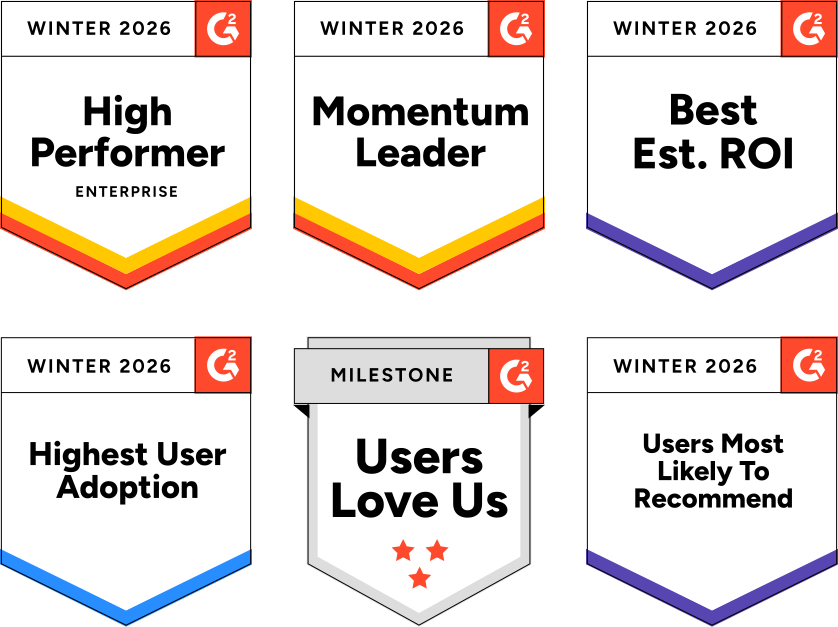
Three G2 badges received by Hex for High Performer, Best Support, and Momentum Leader.

Users love Hex

Rated on G2 as an industry leader based on customer reviews. Check them outarrow-right

Notion
quote
"Our vision for Notion's data team is that anyone, regardless of technical proficiency, is comfortable using data to answer their own questions — and Hex enables that.
Abhishek Modi

Abhishek Modi  Software Engineer at Notion

Instant integration with the whole stack

Out-of-the-box connections and flexible APIs make setup a breeze.

Built for the warehouse

Hex has built-in connections to the most popular data warehouses, lakehouses, and databases. It’s easy to set up data connections, and securely share them with your team.

Learn morearrow-right

dbt metadata, docs, & metrics

Hex has a deep integration with dbt, including automatically enriching schemas with dbt docs.

Learn morearrow-right

Connect to your warehouse with oAuth

Leverage the permissions set up in your data warehouse, by authenticating with oAuth

Learn morearrow-right

Git it together

Export your projects to GitHub or GitLab to create an audit trail.

Learn morearrow-right

Orchestration

You can include Hex projects in DAGs in Airflow, Dagster, or Prefect.

Learn morearrow-right

Hex API

Want to connect to something we haven't thought of? Use our powerful public API to write your own integrations.

Learn morearrow-right

Getting started is easy.

Connect Hex to your data warehouse and do more with it immediately.

Check out all of our plans to fit your team or organization.

See our plans

FAQ

What is Hex?
chevron-down
Hex is the AI Analytics Platform where trust meets insight: a single, connected workspace where data practitioners run deep analysis, business users ask questions in plain language, and everyone collaborates on the same data. A shared context engine ensures every AI-generated insight is accurate and consistent.
What is an AI Analytics Platform?
chevron-down
An AI Analytics Platform combines three capabilities in one connected system: AI agents for deep analysis, conversational self-serve so anyone can ask questions in plain language, and trusted data apps for sharing insights. The platform part is what matters: everything runs on shared context, so every answer is consistent and trustworthy, whether it comes from an analyst's notebook or a business user's question.
Who uses Hex?
chevron-down
Hex allows anyone to get answers from data with AI. Whether you’re a member of the data team running code-based experiments or a business user looking to self-serve a one-off question, Hex provides tailored AI-workflows for you to find answers from data, faster.
Why do data teams switch to Hex?
chevron-down
Data teams switch to Hex because it gives them one connected, AI-native workspace for everything they do with data. Deep analysis, one-off questions, and critical business dashboards all happen on the same trusted context. Instead of juggling separate notebooks, BI tools, and ad-hoc Slack requests, Hex brings data work & AI together in one place.
Can business users access data without knowing SQL or Python?
chevron-down
Yes. Hex lets anyone ask questions in plain language in Hex, Slack, or via MCP and get AI-generated analysis backed by your actual data, metrics, and business rules. No SQL, no Python, no ticket to the data team. And when a question needs deeper investigation, a data practitioner can jump directly into the same workflow without switching context.
How does Hex ensure AI answers are accurate and trustworthy?
chevron-down
Hex's context engine combines database descriptions, semantic models, business rules, and analytical logic into one curated layer that powers every AI answer. Data teams can observe what’s being asked, catch inconsistencies, and continuously improve context over time. The result: business users get answers they can act on, and data teams maintain visibility and control over every insight.
How is Hex different from traditional BI tools like Tableau or Looker?
chevron-down
Traditional BI tools separate deep analytical work from reporting, meaning multiple tools and multiple sources of truth. Hex doesn't make that tradeoff. A complex model built by a data scientist can become an interactive app for business users with one click. When that app raises a new question, anyone can ask it in plain language using all the logic the analyst built. One platform, one shared context layer.
How is Hex different from just using ChatGPT or an AI assistant for data?
chevron-down
Horizontal AI tools don't know your company's data, your business definitions, or your metrics. They generate plausible-sounding answers that may not reflect your actual numbers. Hex's AI is grounded in your real data, connected to your warehouse, and governed by your metric definitions and business rules. The resulting insights are specific, trusted, and consistent — and built to improve the more your team uses it.
How is Hex different than other AI Analytics platforms?
chevron-down
Most AI analytics tools force you to choose between conversational self-serve or code-based analysis. Each runs on different context, produces different answers, and often requires copying and pasting underlying logic across tools just to validate what’s correct. Hex doesn’t just combine these workflows—it connects them. Whether you’re exploring with code in the Notebook or plain language in Threads, every answer is explainable, editable, reusable, and grounded in the same shared context.
How is Hex different than point solution analytics tools?
chevron-down
Hex enables you to bring all your business’s critical data context into one workspace. Solution-specific analytics platforms exacerbate tool sprawl and siloed workflows between teams, while creating governance gaps leading to poor decisions and thrash.
How is Hex different from what Snowflake and Databricks offer?
chevron-down
Snowflake and Databricks are where your data lives: storage, compute, and governance. Hex is where people work with that data. We connect natively to both, so nothing has to move and your existing permissions carry over, and we layer on the agentic analysis, self-serve Q&A, and context tools that turn what’s in your warehouse into trusted answers for data teams and business users alike. Most Hex customers run on Snowflake or Databricks today, and Hex makes that investment more useful, not something to replace.

Can't find your answer here? Get in touch.