
FOR PRODUCT ANALYTICS
Product moves faster when data is in the room
Make any product person a data person.
Used by data-driven product teams

"Hex has transformed how we manage, analyze, and act on data at Kong. Beyond a BI tool, it’s an enabler of data-driven excellence and a strategic partner on our growth journey."
Snehal Karanjkar Data Science Leader

"With Hex’s Notebook Agent, I never have to build another chart again? What a dream come true."
Rie McGiwer and Molly Jane Nicholas AI Insights Researcher and Senior Researcher

"I wrote zero SQL by hand, absolutely zero. Hex is the single most useful and magical tool that has ever existed to make my job better in 20 years."
Tim Frietas Product Manager

"Hex has really enabled us to level up everybody's ability to answer questions using data and decentralize a lot of product analytics."
Mona Khalil Data Scientist

"The CFO is advertising [our data apps] to the rest of the company as 'a million-dollar product.'"
Ben Saxe Head of Data, Huckberry

"With Hex and Snowflake, Doximity was able to completely transition off of Jupyter Notebooks."
Erik Selin Engineering Director Data Platform

"Hex is where we go to understand the deep nuances of what's happening — and then act on them before anyone else sees it coming."
Joshua Hanson Data Team Manager

"Since adopting Hex, the data team has churned out a steady stream of analysis, from internal benchmarking to evaluating the effectiveness of metrics."
Matt Palmer Analytics Engineer

"Hex’s Slack integration unlocked silos of data, in governed ways, increasing trusted answers and insights."
Brandon Rochon VP of Data & Analytics and David Adair, Group Product Manager for Cards and Lending

"We like to embed Hex dashboards where teams work."
Ian Macomber Head of Data and Analytics Engineering

Make your next bet based on numbers you can stand behind
See the logic, not just the result
Build with the Hex Agent and keep metric definitions, sources, and calculations alongside the findings.
"I wrote zero SQL by hand, absolutely zero. Hex is the single most useful and magical tool that has ever existed to make my job better in 20 years."
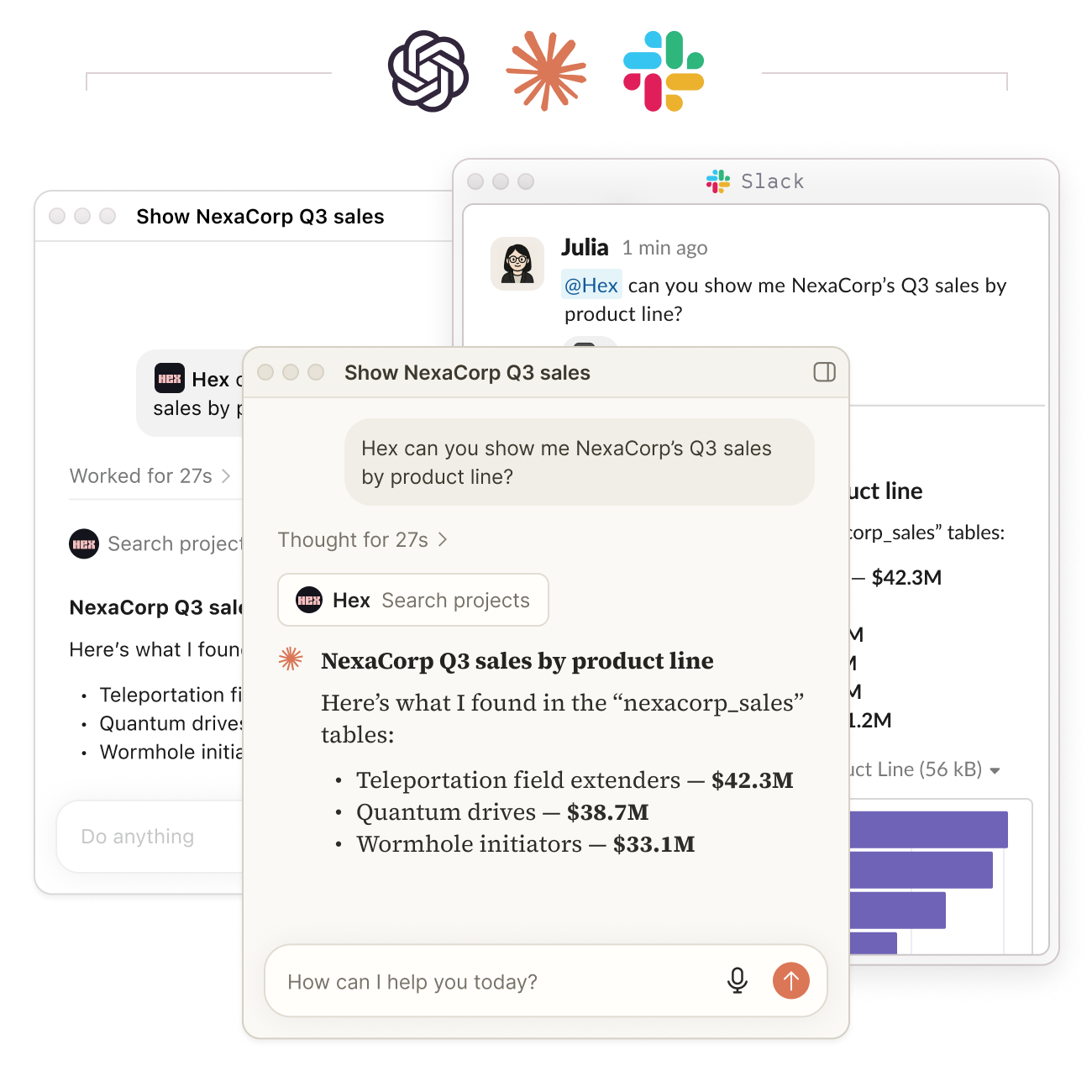
Did that feature move the needle?
Give your team findings they can explore
Share an interactive analysis where your team can compare segments and ask follow-ups to decide whether to iterate, expand, or change course.
10.6x
growth in data exploration across Notion’s team
"Our vision for Notion’s data team is that anyone is comfortable using data to answer their own questions – and Hex enables that."

Know when behavior changes without checking a dashboard
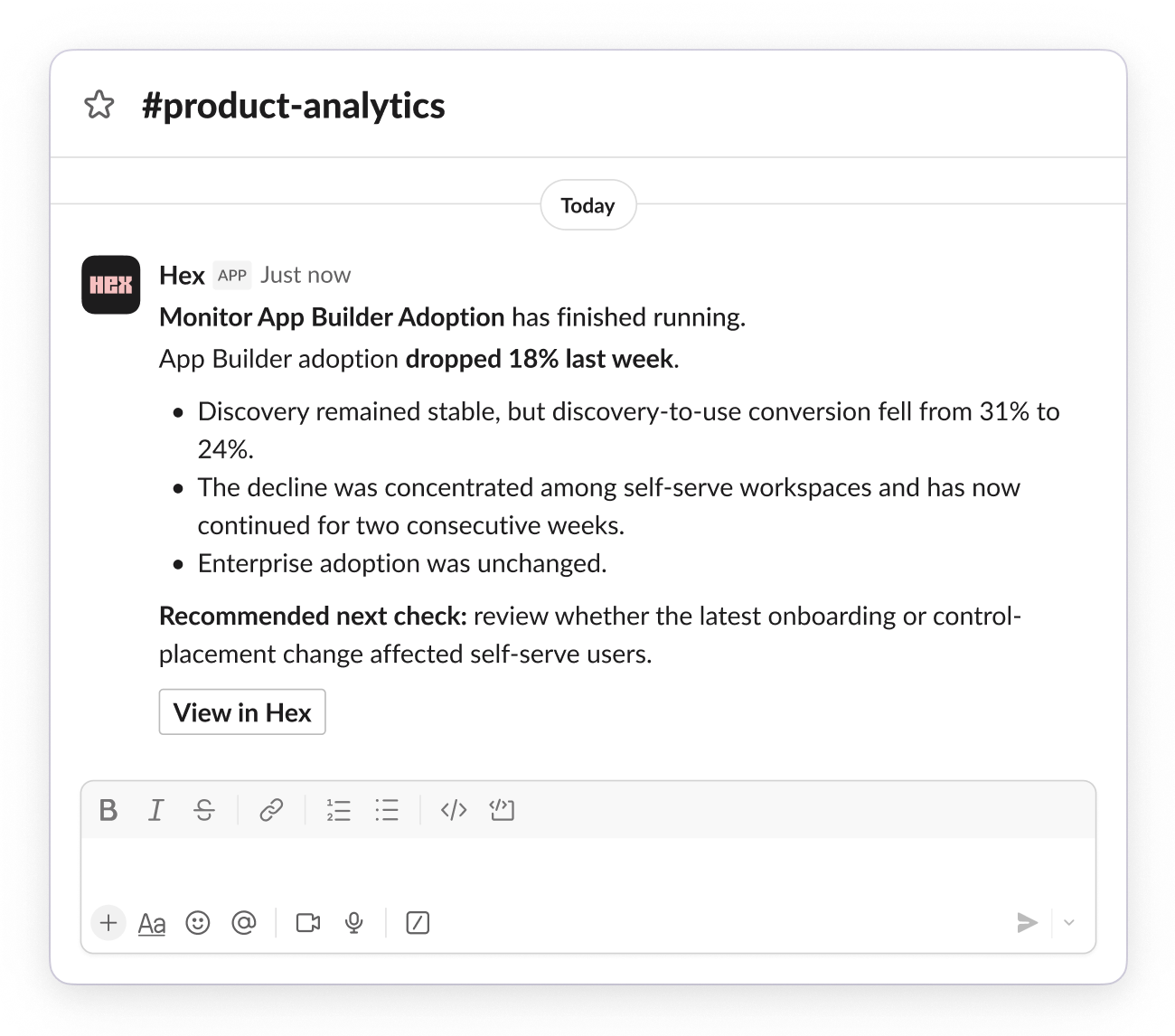
Product updates find you before you think to check
Set Tasks so changes in adoption drops or experiment results find you before you think to check.
"Being able to scale decisions is not just about having a great data product, but putting it into places where people are actually looking and working every single day."
Where to start
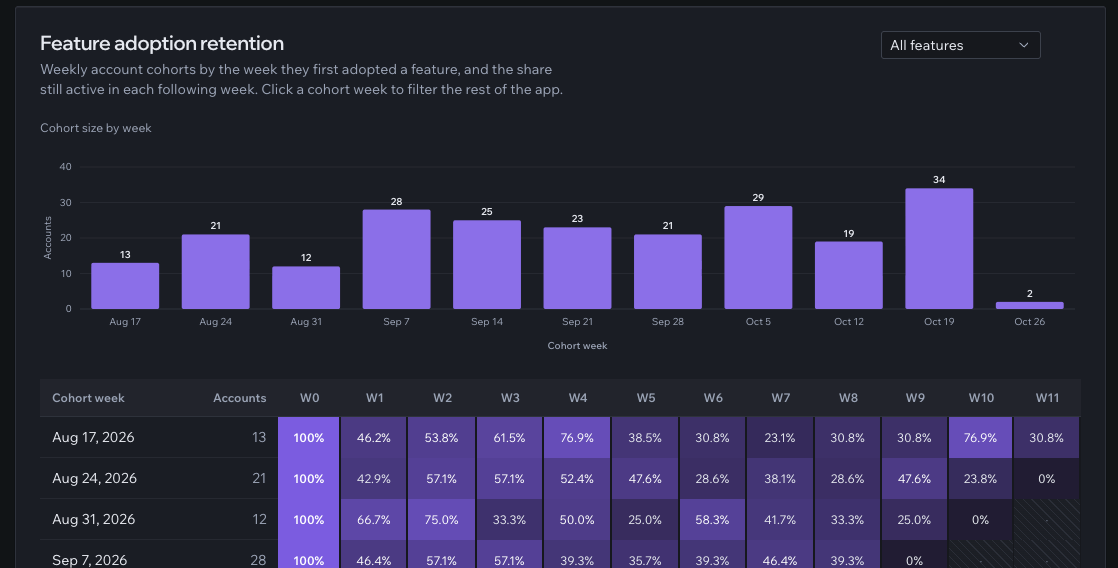
Feature Adoption Cohorts Data App
Group users by when they first tried a feature, then track how adoption holds up week over week.
The Zebra automated A/B testing
The Zebra uses Hex + Eppo to grow their A/B testing practice, running more tests at higher confidence with 50% less manual effort.
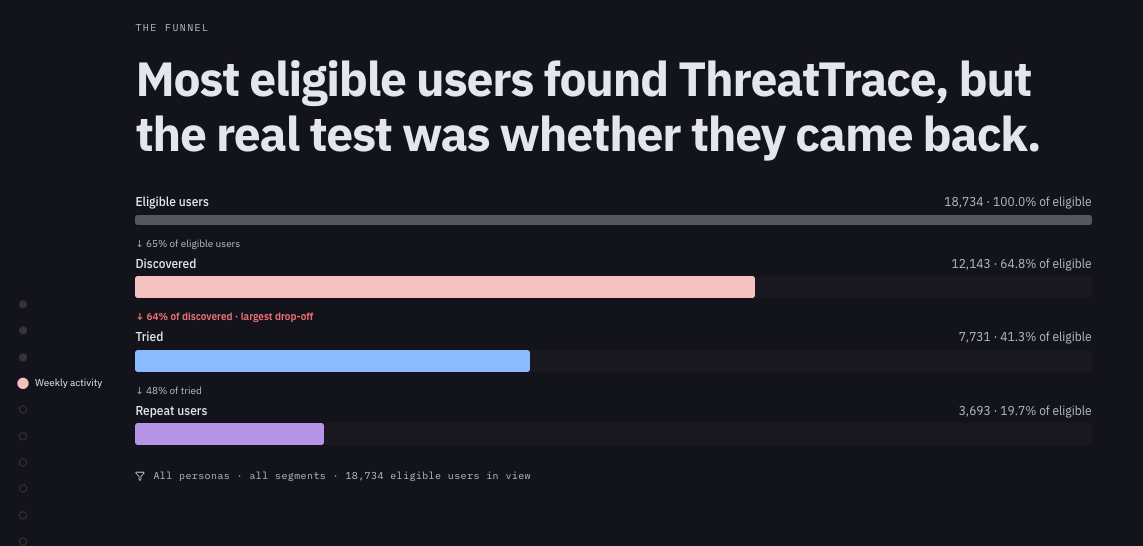
Feature Narrative Deck
Turn launch metrics into a shareable story your product and GTM teams can act on.
Figma accelerated UX research
Figma transformed their UX research pipeline with Hex Agent by tracking 2M+ data points, and automating charts and visualizations builds.
FAQ
For many teams, Hex can do the analysis work of Amplitude or Mixpanel, but it isn't a drop-in replacement. Hex doesn't collect events or track users itself. It analyzes product data that already lives in your data warehouse, such as Snowflake, BigQuery, or Redshift. Teams that already send event data to a warehouse can use Hex for plain-English questions, SQL, Python, and shared apps, all on one trusted copy of the data.
Yes. Product managers can ask questions in plain English using the Hex Agent. Hex's agent writes and runs the queries, returns charts and tables, and explains the logic behind each answer. PMs can adjust charts without code, use interactive apps built by their data team, or get scheduled answers in Slack or email. Data practitioners can still work in SQL and Python.
In Hex, funnels and retention cohorts are built from your warehouse event data, either by asking the Hex Agent in plain English or by writing SQL or Python in a notebook. Hex doesn't have a dedicated point-and-click funnel builder. Each step and cohort definition is written as visible logic your team can review, reuse, and publish as an interactive app with filters for date range, segment, or feature.
Yes, once that event data is in your data warehouse. Hex connects to databases and warehouses such as Snowflake, BigQuery, Redshift, Databricks, and Postgres, not directly to Segment, Amplitude, Mixpanel, or PostHog. Most of these tools can export or sync events into a warehouse. From there, Hex can query those events alongside your other business data, such as revenue or CRM records.
The Hex Agent works directly on your governed warehouse data and your team's definitions, not on files pasted into a chat window. It favors trusted tables and semantic models, follows the business context your team adds, runs real queries, and shows the logic behind each answer. Answers can become shareable notebooks, apps, or scheduled reports. On OAuth connections, queries run with each user's own data permissions.
Hex gives data teams several ways to make metrics trustworthy. Semantic models define metrics like "active user" once, so every answer uses the same definition. Admins can mark tables and models as endorsed to show people and AI what's trusted, and Endorsed Mode limits the agent to trusted data. Guides add business context. The Hex Agent's answers explain their logic, and the underlying queries can be reviewed.
Yes. Conditional notifications on a scheduled Hex app alert you only when a data condition is met, such as adoption dropping below a threshold. Subscriptions deliver an app's results on a schedule. Tasks run the Hex Agent on a recurring prompt, like "any unusual changes in feature usage this week?", and send the answer by Slack or email.