
If you've ever worked a day in consulting, customer success, or anything that requires helping people get value out of software, you've given the "teach a man to fish" pitch. I've given it more times than I can count. And over the years, I assumed something the proverb leaves out: sometimes people don't want to learn how to fish. They're just hungry.
For a long time, I sat with that and quietly filed it under motivation. But that was never the real story. The skills required to fish whatever pond we were standing next to felt like going to the moon for them. The technology wasn't intuitive, the workflows took a dozen clicks to do one thing, and the payoff wasn't big enough to justify the investment. This gets especially stark in data, where you cross the chasm from a SQL-fluent analyst to a business user who has never seen a schema in their life.
I no longer believe those people didn't want to learn. I believe the cost of learning was absurd, so they got in the food line. And the tools we handed them were built to keep them there.
AI changes a lot of this dynamic, for better and worse. But not evenly — bolt AI onto the food line and you've just automated the serving. The tools split cleanly down the middle of the old proverb.
Fed for a day
Teams who choose to be fed usually don't realize that's what they're choosing. The tool assumes everything about their workflows and asks them to conform. The experience is meticulously curated so nobody gets lost: strict flows for building analysis, creating visualizations, and publishing against tightly curated datasets. If you're on the consuming end, you're constrained even further. Filters and drill-downs get you close to your question — never all the way to it.
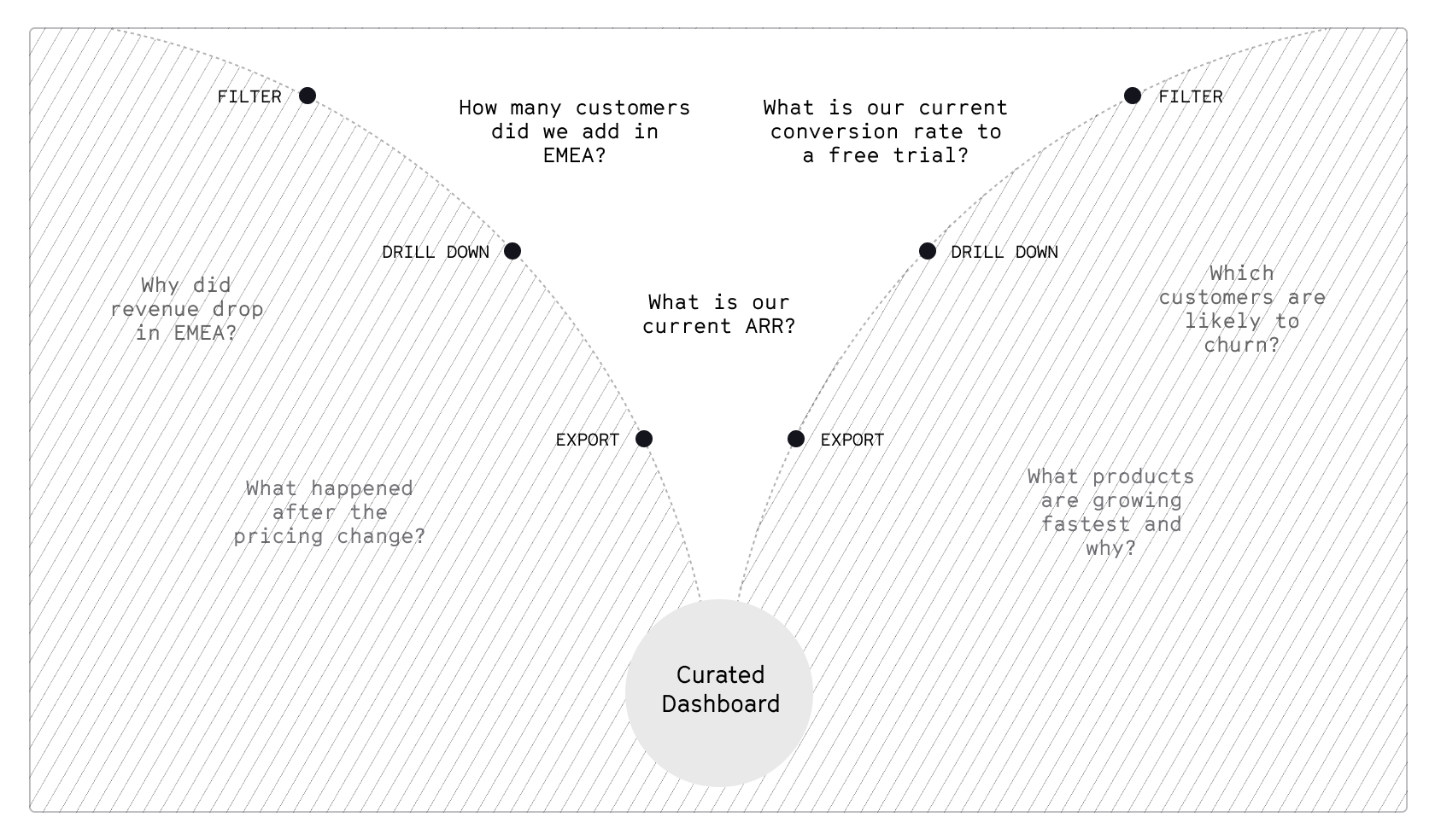
And for a long time, that was the best version of this. We don’t want just anyone hitting the database with a destructive query or SELECT * from the biggest table in the warehouse. But to tell a user that you’re teaching them to fish is disingenuous, and what's worse is that the technologies have reinforced this paradigm in how they built their products.
You’re faced with a monstrous setup (keeping the consulting industry alive, though, so there’s that) that spans months before anyone can get to the insights they were promised. Even the more modern tools with AI baked in still require you to think about all the possible questions someone would ask before anyone is able to use it effectively. When the tool isn’t set up to handle that question, you have to model it and unblock, so long as the queue is clear and there’s time in the sprint.
My main gripe here is that AI makes us feel more like builders than ever before; it’s empowered people to learn something new better than any onboarding seminar or workshop because the payoff is immediate and owned. When analysts want to go deep on a problem, they don't use the tool we're pitching as "self-service." They drop into SQL. The curated experience was never how the fishermen fished. It was how we kept everyone else fed.
Fed for a lifetime
Where I see the space moving, and more teams gravitating to, are the tools that provide primitives, or building blocks, that you can freely use however you’d like. The people who are curious or just impatient get frustrated by UI constraints quickly and move closer to the metal to get the job done.
I find myself drawn to these tools because I am a more “technical” person; the freedom to build things my way and organize information the way I’d like makes it personal to me. I’m not building it against some spec that a product manager mapped out for me. I am working with raw materials that I can shape however I want.
Hex pulled me in for that reason, the same way Excel does for a lot of people, or VS Code and Claude Code. It's a sandbox — a pond, if you'll allow me one more — where I know exactly how to get what I want.
In Hex, the primitives are cells: code, a chart, markdown, chained together and organized to fit the use case rather than the other way around.
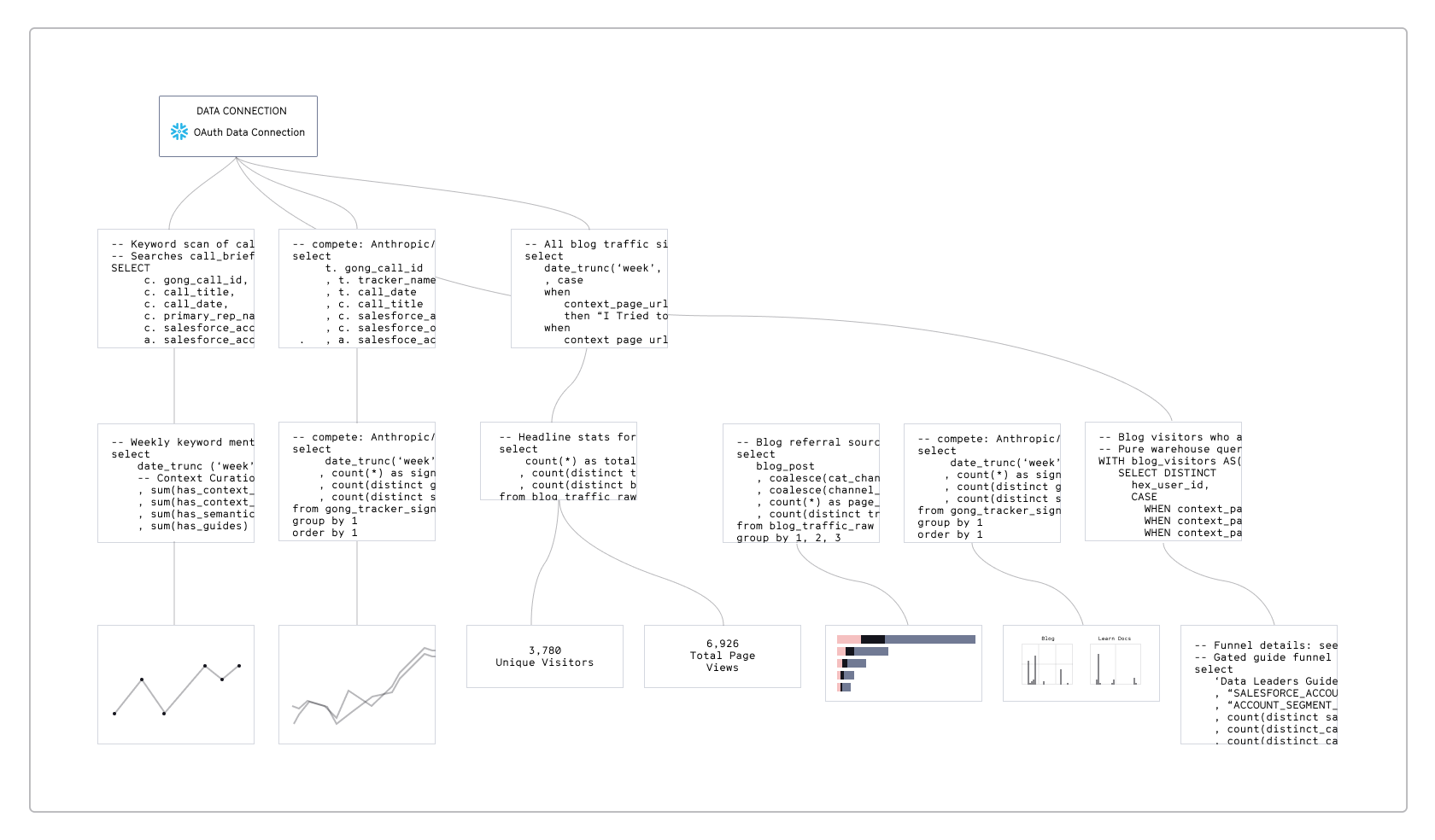
This architecture is special because the workflow’s basis isn't a UI. It's code. Agents can read, write, and reason about code far better than they can learn a sequence of button clicks. And the setup looks nothing like a months-long implementation.
Is it every question ever? Maybe not. But realistically, in Hex it looks like:
- Endorse your 2-3 golden tables
- Document your main 2-3 metrics and business logic in a guide
- Sync a semantic model if you have one
An hour or two, and the first pass is done. From there, the people who were stuck in the food line are fishing a wider, deeper pond than the curated tools ever exposed — with an agent you trained standing next to them the whole way.
We still need to teach, no matter what
AI doesn’t remove the barrier to teaching, just the one to building. Data teams and others who are already fishermen should take the opportunity to educate others on what we know and throw away the old assumptions that people just don’t want to learn.
An agent will hand a confidently wrong answer to someone who has no way to judge it just as smoothly as it hands over a right one. The hunger didn't go away, and neither did the need for fishermen who know the water.
Now we should teach business users how to prompt effectively instead of the right filter combinations. We teach them how to spot a bad result based on their intuition and where to raise that concern, or how to push back with the agent to get a better result.
Data team’s workflows change too. You’re reviewing agent conversations and seeing questions arise that you had no clue were being thought of.
You’re getting a much clearer picture of what matters at your organization and how to help them.