
Everyone is asking for agents on data, but what does that really mean?
The data team is playing around with coding agents, business users are exporting CSVs out of their dashboards and loading them into ChatGPT, and meanwhile every data tool in the world is talking about how they have this cutting edge agent that will solve all of your problems. What’s crazy about this is how the technology is new, but the problems feel all too familiar…
For a long time, data has worked the same way. Organizations collect a lot of data, theorizing that they’ll get insights out of it some day, and at some point someone says “how do we get insights from this?” Then the organization spends a bunch of money slapping dashboards on top of the data, maybe accompanied by some advanced tools for specialists who want to go deeper, and creates a service center for people to request new answers. At the end, there’s…a lot of dashboards floating around.
Every once in a while, someone complains that they can’t get answers from data fast enough, and (if that person is senior enough) it spins off a modernization project that results in…more dashboards, this time in a newer tool. This cycle has re-established itself over and over for the last 20 years or so.
But something has changed about how we interact with technology. We can talk to computers now, and it’s causing people to think more critically about what they should accept.
It’s tempting, whenever there’s a big change to technology, to just do the same thing again. “Let’s just re-invent the whole dashboard paradigm over again, but with chatbots” is common strategy for data startups. But as we’ve started to work with AI, it’s become clear that there’s an opportunity to rethink the problem altogether.
AI and data are converging in a way that allows us to create a platform for everyone, regardless of technicality, to get insights.
Now, if you’ve been following Hex for a while, you know that we’ve been hard at work on this since before there were LLMs. We founded Hex around the belief that everyone can be a data person. We invented a fast, flexible platform for data scientists to do advanced analysis with Hex notebooks, and a way to turn insights into interactive reporting with our data apps. But a little over a year ago, it became clear that the opportunity is bigger than that - AI and data are converging in a way that allows us to create a platform for everyone, regardless of technicality, to get insights.
Today, I want to give you an overview of what we think that means, and how it will come to life as a new standard for data, for everyone.
The AI Analytics Platform
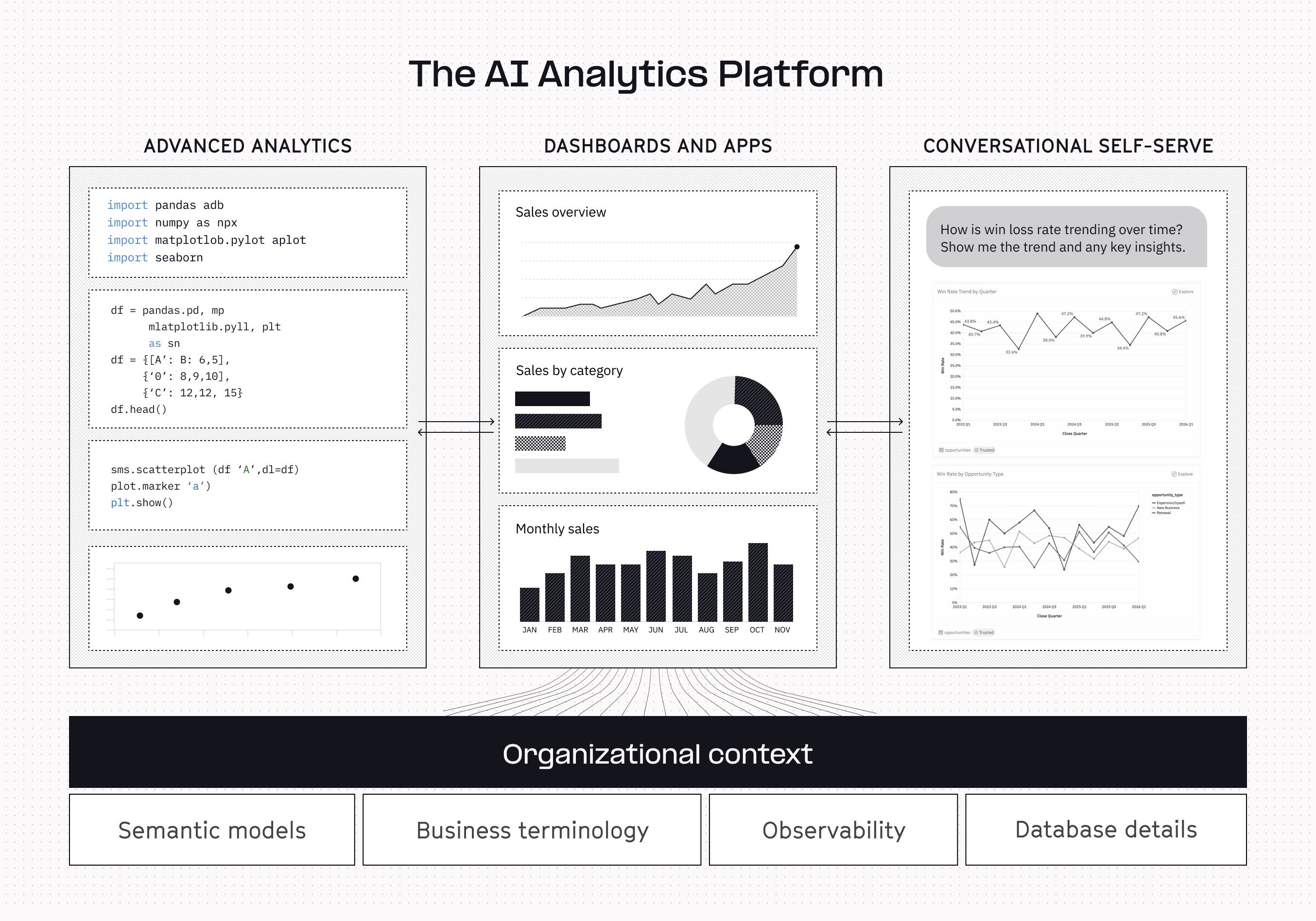
An AI Analytics platform is one, connected system that provides agents for deep analysis, conversational self-serve, and data apps.
It provides agentic tools for data practitioners to do advanced work, and intuitive AI-powered interfaces for non-technical users in any part of the business, no matter the use-case, to ask questions without having to learn new technical skills.
Importantly, all of these tools need to work together in a single platform, allowing every answer to become context that improves future answers, and the data team can curate this context to ensure insights remain trusted and consistent.
AI Analytics platforms allow customers to modernize their approach to analytics, bringing data teams and their stakeholders together, focusing on insights over reports and dashboards.
A Single Platform
One place for everyone to collaborate - not “different tools for different folks.”
The old way: fragmented. The new way: unified
Teams today have different tools for BI & Dashboards, advanced analytics, spreadsheets, and metrics. The impact is that people can't work together - the number in the dashboard might not match up to what's in someone's spreadsheet, and people can't come to a consensus, because there's no consistent, trusted set of facts.
With AI Analytics, people are united. AI can be a pair programmer with more advanced analysts, and enable less-technical users with natural language - but mostly importantly these interfaces need to talk to each other. With AI in the mix, a unified toolset becomes a requirement. Anyone can ask a question of data and get a quick answer, and the answer can be built upon by more technical users. A conversational interface that enables everyone, and a deep agentic analytics toolset, without people needing to jump between tools.
Finally, data experts and business stakeholders can work together to make decisions.
Advanced Work
Deep, instructive answers, not just simple aggregations.
The old way: simplistic. The new way: nuanced
Dashboards are for simple, reusable insights - you aggregate some data from the warehouse and summarize it into a report with some filters. The problem? People don’t really get what they need. Every answer leads to new questions. They go to a meeting and bring some data and their boss asks some follow up questions and the conversation just...kind of ends. People end going on gut, or they schedule a meeting for a couple weeks later to look at the next pass at the data. It's a constant tradeoff - do we make the decision now? Or do we wait for more analysis?
Now, AI removes the “depth vs scale” tradeoff - dashboards don’t have to merely contain surface information anymore, so tools are evolving to allow people to incorporate advanced, predictive, and iterative explorations more readily into their dashboards. If you’re looking at AI Analytics and the tools don’t enable data scientists and analysts to do deeper work, your reporting is going to fall short.
Complete Context
A comprehensive set of tools for trust, accuracy, and governance.
The old way: untrusted. The new way: cohesive.
Choose your adventure: 1), a wild framework where everyone is defining their own metrics, there are 17 different definitions of “Renewal Rate” and no one trusts the data. Or 2), the data team locks down all the metrics and restricts any free form analysis to the point that no one can really get what they need.
This tradeoff is no longer acceptable. AI Analytics Platforms need the flexibility use models, business rules, raw data, and/or existing answers to deliver trusted insights. Guardrails to give AI the context, judgement, and tools necessary to deliver useful answers. Another requirement is observability: data teams are becoming context curators, necessitating the ability to see how their approach to context is working. This way, they know where to build context, and in which areas they can pull away from “qq”-style questions and refocus on the bigger, more strategic analysis that will have the most business impact.
The Temptation of the Status Quo
This definition is bigger than just us. The category needs to evolve to support this new standard. It is tempting, however, to try to fit into an existing category like BI and build software that does a lot of the things BI does - that approach has marketing advantages like fitting into existing budget line items and creating a simpler migration path for customers.
We firmly believe that orgs who buy modern BI tools will find themselves doing another migration in 12 months
Some vendors are doing this! It’s a lot easier, if you’re not thinking too far into the future, to say “let’s just migrate all our Tableau dashboards to this new tool that has a little AI sprinkled on top” or “hmm, we already know Looker pretty well, and this looks like a modern alternative.” But we firmly believe that orgs who do that will find themselves doing another migration in 12 months - because their users and stakeholders will increasingly demand AI-native experiences, and dashboards will continue to fail at meeting the needs of the business.
We think that type of thinking is limiting - it’s the type of “faster horse” thinking innovators have battled for generations. But defying it is the only way truly transformative innovation happens. We’ve based our definition of AI Analytics on the end-state platonic ideal for data teams and their stakeholders: anyone can work with data, everyone can trust data insights, and insights are influential and strategic in decisions.
If you want to skate to where the puck is going, this is it.
More on Data