Blog
Your code knows things your warehouse doesn't
Expand the agent's context with your repos and unlock answers only engineers had before

tl;dr: Connect your Git repos to Hex and the agent will use them to understand the logic behind your data — not just what's in it.
Data teams spend a lot of their time making data easy to understand, easy to query, and ergonomic. A good data mart is a high-leverage tool — blessed, safe to use, hard to get wrong with good abstractions, good names, helpful documentation.
Until someone asks a question that requires understanding how the data was built, not just what it contains.
- What values are getting filtered out here?
- What does this column actually mean?
- How was this feature implemented?
These questions are impossible to answer without knowing how the data came to be. The answers live in your dbt models, your app code, your transformation logic — scattered across repos that, until now, had no connection to where your data work actually happened.
Today, that changes. You can now attach one or many repos to your Hex workspace, and the Hex Agent will analyze, parse, and synthesize them. Now anyone can understand not just what the data says, but how it got there.
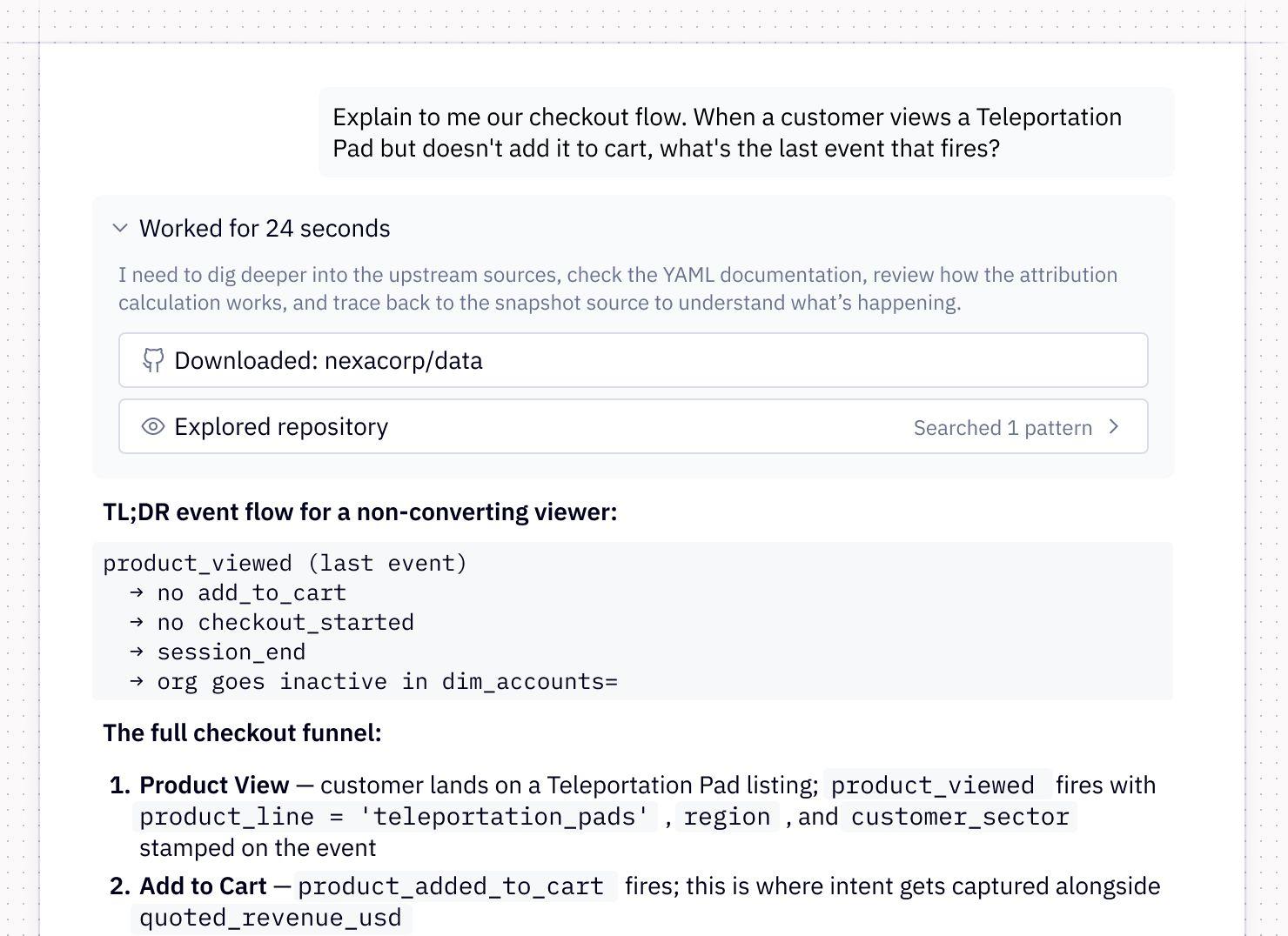
Use case: dbt repos
Even with a great data mart and extensive documentation for each column and table, there is inherently a lot of valuable nuance in the upstream logic that traditionally only the data team could figure out and answer.
Simply connect your dbt repo to Hex, and even with your self-service users still querying high level tables, the agent will be able to better construct queries and understand limitations of the mart tables by crawling up and inspecting upstream logic.
- What values are getting filtered out
- Are there blanket cases we exclude
- what values are getting collapsed and simplified in which
- Where are these categories coming from?
Self-service users keep querying the high-level tables they already know. The agent handles the rest.
Use Case: application repos
Many self-service data workflows begin with a dbt repo — but they struggle when a question requires combining data context with an understanding of how the product actually works.
- How did we implement tracking?
- What isn’t being tracked?
- What set of events should be analyzed together and how do they relate in a feature?
Connect your application repo and the agent can reason its way through your codebase to answer those questions directly. Combined with your data transformation repo, this gives the Hex Agent an incredible depth of context on how to analyze your company's data.
Context that compounds
A large part of how your business views the world is already explicitly written as code. And that logic is constantly evolving, just like the data it produces.
You need an agent that can bring together context from multiple sources — repos, existing projects, warehouse metadata, guides, semantic models — synthesize it, and intelligently draw from the right sources to answer the right question. In Hex, simply connecting your repos gives you exactly that.
Your business, your code, and your data are constantly changing.
If this is is interesting, click below to get started, or to check out opportunities to join our team.


