FOR DATA LEADERS
Unlock the speed of AI analytics, without losing sight of a single question, answer, or cost.
You shouldn't have to choose between giving people AI on your data and knowing the answers are right. Every answer in Hex draws on context your team controls, and that context improves each time someone asks a question.


Say goodbye to your queue of tickets

Self-serve analytics that actually sticks
Your stakeholders want an answer in whatever window they already have open. They can ask in Slack, inside a published app, or through Claude, ChatGPT, and any MCP-connected system. Calibrate the agent to your business teams need based on preference of cost and depth.
Proof: Neo Financial
10.6X growth in data exploration. Every employee gets answers via @Hex in Slack under their own permissions.
Stop answering the same question for the fourth time

A good answer can be reusable forever
Every conversation in Hex is a project that you can open, check, and turn into a reusable, governed artifact. Endorse your top loved apps so that their logic joins your context, so the next question starts from work you've vetted.
ROI proof
Palmetto eliminated a $60K Looker contract and avoided a $170K Omni migration.
Product managers and data scientists now co-create inside the same Hex notebook — sketching ideas, refining metrics, and seeing results in real time.

Skip the upfront modeling project

Start with the context you already have
Hex reads what you've already written: table descriptions in your warehouse, dbt models, docs in Notion, rules in your repos. Endorse the tables your team trusts and monitor the answers the agents produce, so you know where to build more guardrails and models.
Context Studio changed how we manage agent performance. It surfaces gaps, proposes fixes, and suggests exactly where to add context. The agent improves without me auditing every conversation.

Context is not a constant
Make sure your context keeps pace with the business
Hex monitors its own answers and provides suggestions for fixes that would help improve answers the most. Then check the agent's work by running Evals to test context and configuration changes.
What is AI already telling your stakeholders about your data?
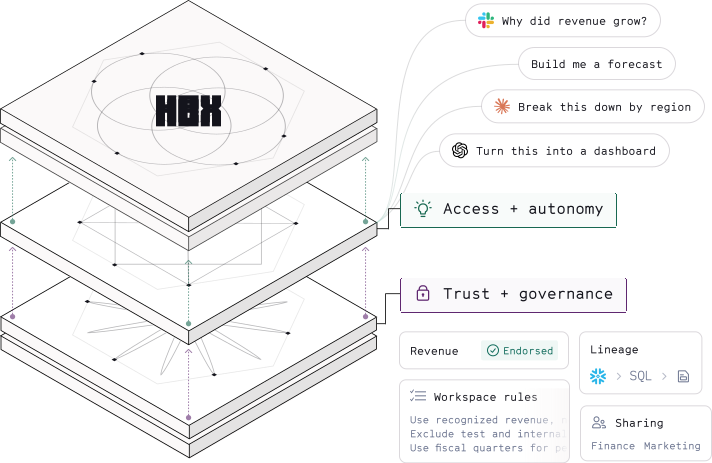
Govern every question, answer, and dollar spent
In Hex you can see the question, the answer, which model it used, which tables it used and which metric definitions. When an answer comes back wrong or out of budget, you can trace it back to the root cause and make sure the same mistake doesn't happen twice.
Hex is where we go to understand the deep nuances of what's happening — and then act on them before anyone else sees it coming.

FAQ
No. Business users never touch a notebook. Their surfaces are Threads (natural language Q&A over curated warehouse data) and data apps (interactive experiences analysts build once). The notebook is where analysts work; apps and Threads are how that work reaches the business.
Yes. Threads is natural language Q&A over your company's data with no SQL required for the end user. Data apps give business teams parameterized experiences to explore on their own. At Neo Financial, every employee gets answers by asking @Hex in Slack under their own data permissions.
Hex replaces existing BI and data tools rather than adding another layer. Analytics workflows are already scattered across notebooks, BI, spreadsheets, and Slack; Hex consolidates exploration, apps, and governed AI on the stack you already trust.
Most teams triage first and migrate high-traffic dashboards incrementally. Redis completed a full migration in six months, going from 1,000 dashboards to roughly 150 in Hex. Hex also provides a CLI-based workflow that uses AI to translate dashboard exports into Hex projects programmatically.
No. Neo Financial saw Threads work effectively with well-documented metadata before full semantic coverage. You can endorse trusted tables, add workspace rules, and layer semantic models over time while Context Studio suggestions surface what to add based on real questions.
No. Warehouse-level permissions are the hard enforcement layer. Hex's AI operates within whatever entitlements the user already has in Snowflake, BigQuery, and other warehouses. Schema filtering shapes agent context; warehouse roles control what can actually be queried.
Context Studio defines what AI can see and say — endorsed tables, metric definitions, workspace rules, and semantic models. PandaDoc connected Threads to their semantic layer for governed natural-language access with a SQL audit trail. Self-serve expands what users can ask; it does not expand what they can see.
Accuracy comes from context, not just the model. StubHub chose Hex because Threads let them focus on curating trusted data and metric definitions instead of maintaining chatbot infrastructure. Context Studio surfaces warnings when answers drift so teams can fix issues before trust erodes.
Kong cut ad hoc requests by 30%+ and saved 240 hours annually after deploying Threads for self-service. Threads handles recurring what-happened questions while data apps encode known workflows once, so analysts stop re-answering the same tickets and build assets that scale.