Blog
What is semantic AI in the world of data?
AI that understands your business starts with shared definitions. Here's why semantic AI matters for data teams.



You've probably sat through a meeting where two teams argued about a number because they used the same metric name with different definitions. Marketing says customer churn is 8%. Finance says it's 12%. Both are technically correct, but they're using different calculation methods buried in different spreadsheets or dashboards. The conversation stalls, trust erodes, and nobody's quite sure what "churn" actually means anymore.
This is the kind of problem semantic AI addresses. It gives your data a shared vocabulary: clear definitions that everyone uses the same way. AI tools can generate useful analysis from warehouse schema alone, but semantic layers make those results consistent and governed across teams. Once a semantic layer is in place, other AI tools (like generative AI for analysis or agentic AI for automation) produce more reliable results because they're working from shared definitions rather than raw column names.
What is semantic AI in data?
Semantic AI uses the semantic layer to interpret questions and generate accurate answers. The semantic layer is a translation system between your database tables and the plain-English business terms most people use. It holds the governed definitions; semantic AI is what makes those definitions actionable, helping teams author models, write queries, and deliver trusted insights.
Instead of forcing everyone to learn table names, join conditions, and SQL syntax, semantic AI lets you work with terms like "Revenue," "Active User," or "Customer Lifetime Value" and trust that they mean the same thing everywhere.
Your warehouse stores tables and columns; your business talks in metrics and KPIs. The semantic layer bridges that gap by encoding business logic, relationships, and definitions into a structured layer that sits between raw data and the tools people actually use. Semantic AI then uses that layer to deliver accurate, context-aware answers.
The technical implementation relies on knowledge graphs that link data sources together by mapping how different tables, fields, and business concepts relate to one another. These graphs form the backbone of the semantic layer, standardizing business logic and providing consistent definitions across different domains. Because the semantic layer encodes these relationships explicitly, when someone asks a question — whether through a dashboard, a natural language interface, or a custom application — everyone gets answers built on the same definitions. Without it, business logic scatters across dozens of reports, dashboards, and SQL queries, with each analyst recalculating the same metrics independently.
Semantic AI vs. generative AI vs. agentic AI
These three terms get conflated often. They serve distinct purposes in data workflows.
Semantic AI focuses on meaning and structure. It's about understanding relationships between data elements, interpreting business logic, and ensuring consistency. Semantic AI uses the semantic layer and other forms of context like workspaces guides as the governed foundation to produce accurate analysis and make other AI systems more trustworthy.
Generative AI creates content and assists interpretation. In data contexts, this means writing SQL queries from natural language prompts, generating documentation, summarizing patterns, or helping analysts explore unfamiliar datasets. You're still making the decisions; GenAI accelerates the technical steps between your question and the answer.
Agentic AI takes autonomous action. Agentic AI systems can plan, execute, and adapt without constant human oversight. Agents have access to tools (APIs, databases, external systems) that let them act, not just generate text. In data workflows, this means automatically adjusting pipelines when source schemas change or flagging anomalies in near real time.
These approaches build on each other rather than compete. The semantic layer provides a foundation for governance, a shared understanding of what metrics mean and how data relates. Semantic AI uses that foundation to interpret questions accurately. Generative AI helps people work faster. Agentic AI executes operations confidently because it's working from consistent, governed definitions.
Most data teams benefit from establishing semantic foundations early, but you don't need a complete semantic layer to start getting value from AI Analytics. Many teams begin with AI agents querying warehouse metadata directly and layer in governed definitions as they identify where inconsistency causes the most pain.
5 benefits of semantic AI in analytics
Semantic AI reduces the friction between how your data is stored and how your business actually talks about it. It works by giving AI systems context about what your data means — and that context exists on a spectrum.
Endorsed tables and thorough warehouse descriptions give today's LLMs enough to generate accurate answers for most questions. Workspace guides add behavioral guardrails. Full semantic models are the gold standard, formalizing metric definitions so every tool and every team computes them the same way. The richer the context, the more consistent and governed the results. Here's what improves as teams move along that spectrum.
1. Consistent metric definitions
Every team uses the same metric definitions, regardless of which tool they're working in. When metric definitions live in a semantic layer, "Revenue" means the same thing whether Finance pulls it into a spreadsheet, Product embeds it in a dashboard, or an executive asks about it in plain English. This cuts down on the reconciliation conversations that drain data team productivity.
Teams don't need to start here. Endorsed tables and clear warehouse descriptions give AI agents enough context to produce consistent answers for well-scoped questions. Semantic models formalize that consistency across the full organization. But the improvement is incremental, not all-or-nothing.
Teams that implement semantic layers typically see reconciliation work drop significantly. Hours that previously went to chasing down why churn numbers differed across tools can shift to analysis that actually moves decisions forward.
2. Fewer ad hoc requests for data teams
Business users can answer their own questions without filing tickets or waiting on analysts. Data analysts know the pattern: a "quick question" arrives in Slack, you write the query, send the results, and two days later there's a follow-up asking for a slightly different cut.
Even lightweight context — endorsed tables, workspace guides — gets self-service working: business users start answering their own questions without filing tickets. Add semantic models and the guardrails tighten further, but the ticket queue starts shrinking well before that.
3. Business-friendly data access
Most stakeholders don't need to understand table names and join conditions. Semantic AI lets domain experts contribute their knowledge and access data using the terms they already use.
A marketing manager can query "campaign performance by channel" without understanding the six tables and four joins that produce that answer.
4. Faster onboarding, less tribal knowledge risk
New team members can find and understand metric definitions without relying on tribal knowledge. When business logic is scattered across individual analysts' queries and undocumented spreadsheets, losing a key team member means losing critical knowledge.
Semantic layers codify that logic explicitly, making it discoverable and maintainable. New analysts ramp up faster, and the organization isn't dependent on any single person's understanding of how metrics work.
5. AI readiness
The more context AI has about your data, the better it performs. And that context doesn't have to start with a semantic model. Tools like Hex can generate useful analysis from warehouse schema and table metadata alone. Add endorsed tables and workspace guides, and accuracy improves further. When you layer in semantic models and an LLM knows that "MRR" and "monthly recurring revenue" mean the same thing, and knows exactly how to calculate it, the answers become trustworthy and consistent across every team and tool.
Organizations don't need to wait for perfect semantic coverage to start getting value from AI analytics. Start with what you have, identify where inconsistency causes the most pain, and deepen context there first.
Semantic layers improve that accuracy by giving AI governed definitions instead of raw column names to interpret. Organizations that build these foundations see better results from every AI tool in their stack.
How semantic AI actually works
Semantic AI translates your raw data into business terms people actually use. It does this through four components: a semantic layer that defines metrics, knowledge graphs that map relationships, vector embeddings that support semantic search, and natural language processing (NLP) that converts questions into queries.
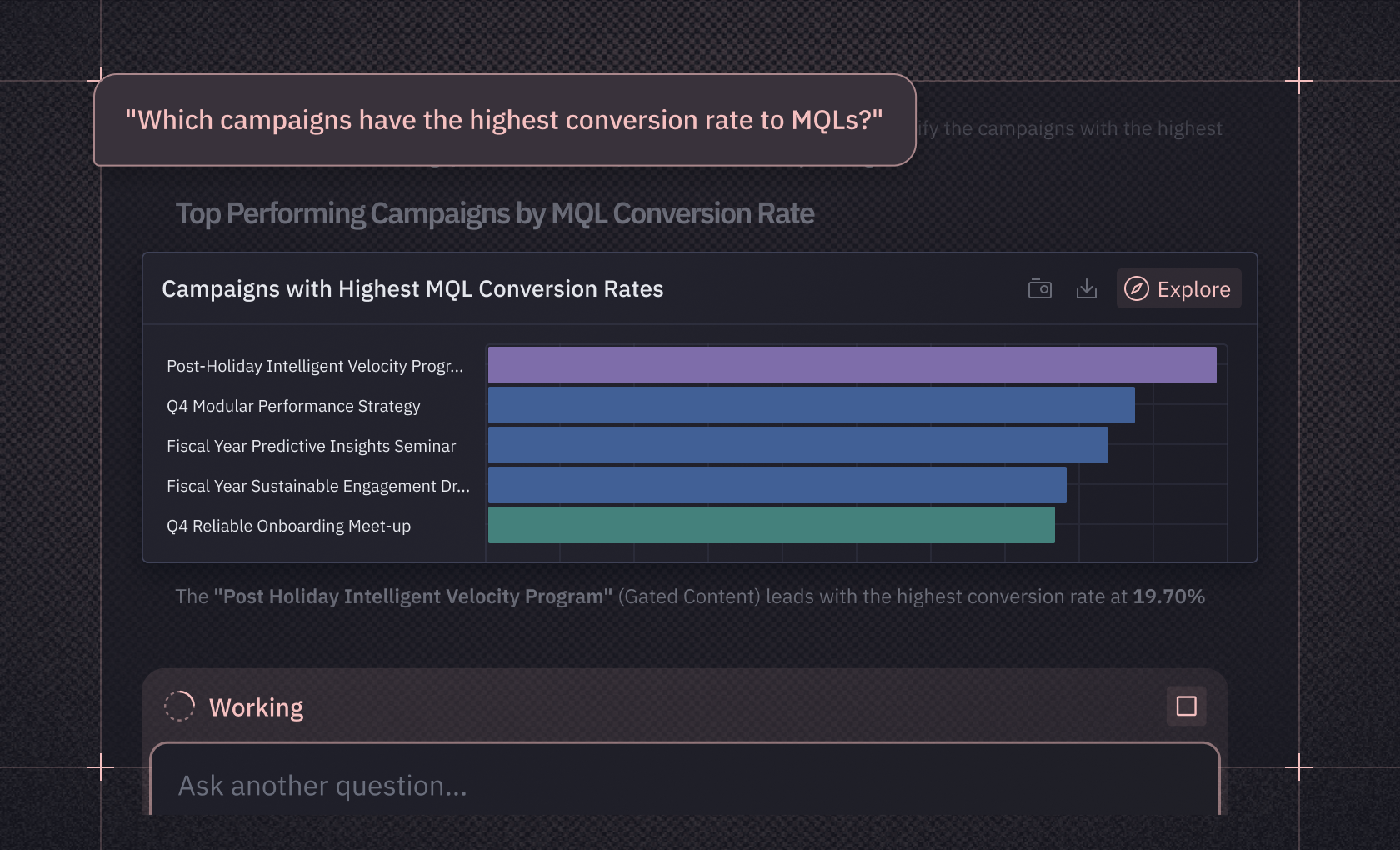
Even without a full semantic layer, Hex's AI agents can query your warehouse using schema metadata, endorsed tables, and workspace rules — and they produce accurate results the majority of the time. Add a semantic layer, and you get governed definitions on top. For example, type a question like "Which campaigns have the highest conversion rate to MQLs?" and Hex knows exactly what "MQLs" means, which tables to query, and how to calculate the result.Hex integrates with semantic layers from tools like dbt MetricFlow, Cube, Snowflake Semantic Views, and Databricks UC Metric Views, so you get governed metrics through natural language while maintaining full visibility into the underlying SQL.
And if you need to build or extend those semantic definitions, Hex's Modeling Agent helps data teams define measures, dimensions, and joins directly in the Modeling Workbench — with autocomplete, inline validation, and AI assistance that speeds up the modeling process.
Here's how each component works:
The semantic layer defines business concepts
The semantic layer sits between your data sources and everything else. It maintains business concept definitions separately from physical database structures. When you query "Monthly Recurring Revenue," the semantic layer knows which tables to pull from, how to calculate the metric, and what filters or aggregations to apply, regardless of whether you're accessing that metric through a BI tool, a natural language interface, or an embedded application.
Knowledge graphs map relationships between concepts
Rather than isolating each metric, semantic AI systems capture how business entities relate to each other. A "Customer" connects to "Orders," which connect to "Products" and "Revenue." These relationships let you ask more sophisticated questions. You can query across multiple concepts without manually specifying every join condition.
Vector embeddings enable semantic search
Modern implementations convert text, metadata, and business concepts into high-dimensional vectors that capture semantic meaning mathematically. This allows similarity-based retrieval where conceptually related terms are clustered together. Effective semantic AI systems combine vector-based search with explicit mapping through knowledge graphs and ontologies, allowing systems to reliably understand that "monthly revenue" and "MRR" refer to the same business concept.
Natural language processing translates questions into queries
When someone types a question, NLP components identify the intent, extract relevant entities, and generate the appropriate query against governed data sources. The semantic layer provides definitions, knowledge graphs provide relationships, and vector embeddings help match informal language to formal concepts.
Semantic layers show you exactly how metrics are calculated and where data comes from. That transparency matters for data teams who need to trust and validate what AI systems produce.
What it takes to implement semantic AI
You don't need a complete semantic layer to start. Many teams begin leveraging AI Analytics on existing data structures and layer in semantic definitions as specific pain points emerge. But adopting semantic AI as a deliberate strategy involves more than tool selection; organizational readiness and data infrastructure maturity shape the outcome.
Most organizations face a few common challenges:
Data quality and governance gaps. Your data doesn't need to be perfect, but it does need to be reasonably clean, and you'll need governance frameworks that address AI-specific concerns. Organizations that skip these foundations tend to stall during implementation — not because the technology failed, but because the groundwork wasn't in place yet.
Cross-functional alignment. Data teams and business stakeholders need to agree on definitions and priorities. Without this alignment, semantic layers end up reflecting one team's view rather than a shared understanding.
Tool complexity. Organizations often manage many specialized data tools, and data leaders frequently cite stack complexity as a challenge. Adding semantic AI to an already complex stack needs careful planning. 57% of analytics practitioners are either managing data for AI training or plan to do so within the next 12 months.
Adoption momentum. The direction toward making data more accessible and meaningful across organizations is clear, but the transition takes sustained effort. Start small by identifying a few high-value metrics where inconsistent definitions cause real pain, build semantic foundations for those specific use cases, and expand from there.
Ongoing observability and improvement. Implementation isn't a one-time project. Once teams are using AI analytics, data leaders need visibility into what questions are being asked, where agents are relying on thin context, and which metric definitions need tightening.
Hex's Context Studio gives data teams that feedback loop — surfacing frequently asked topics, flagging quality issues, and showing where deeper governance would have the most impact. The teams that improve fastest are the ones that can see where their context gaps actually are.
Moving forward
Semantic AI gives your existing AI tools a governed foundation to work from. Without shared definitions, AI produces confident but inconsistent answers. With semantic foundations in place, AI-assisted analytics becomes more useful: faster insights, broader access, and trustworthy results.
Semantic AI won't solve every data challenge, but it makes sure everyone's working from the same understanding of what the data actually means. When definitions are consistent and governed, data teams spend less time reconciling conflicting numbers and more time on analysis that moves the business forward.
Ready to see how this works in practice? Sign up for Hex or request a demo to explore how governed metrics and AI-assisted analytics work together.